
Real Estate Contract Management Software: Streamline Your Contract-to-Close Process in 2026
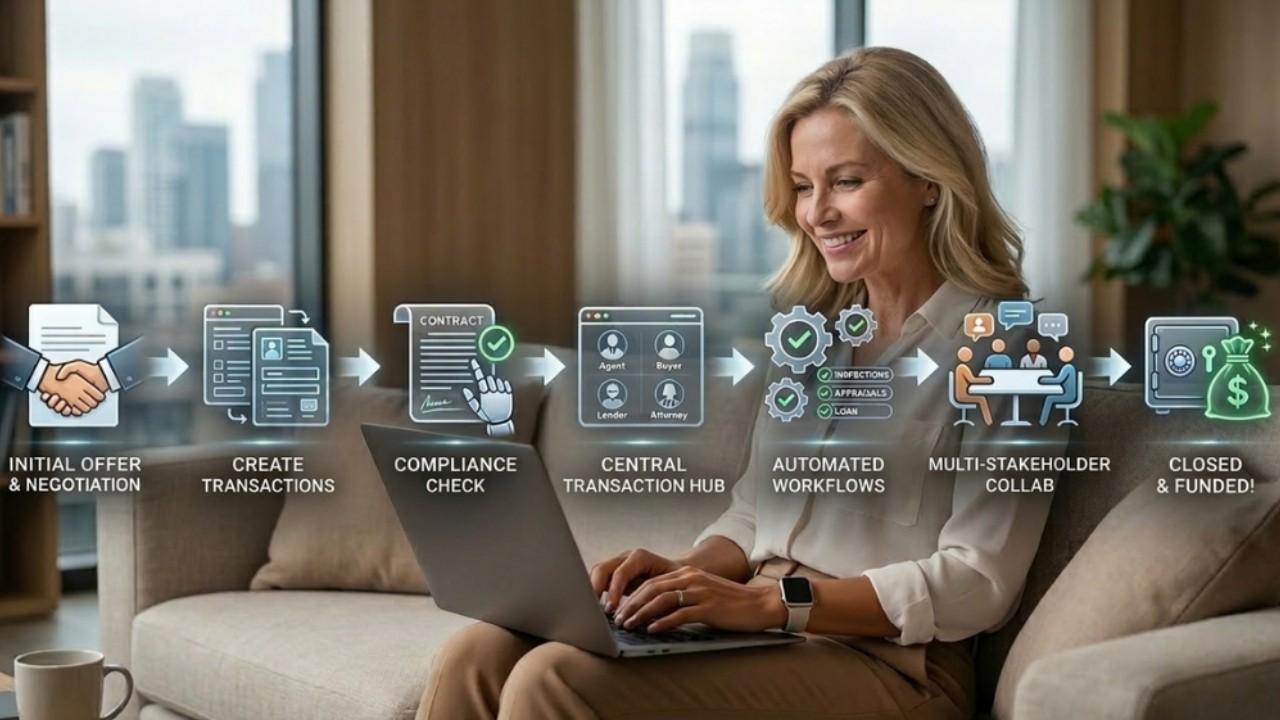
“One missed deadline. One lost document. One delayed approval. And all of a sudden a good real estate business deal falls apart.”
In real estate, the success of every deal is based on the efficiency with which the process of contract-to-close is handled. Getting a property under an accepted offer to a successful closing involves a giant web of documents, countless deadlines, and ongoing communication among multiple parties. Even a drop of a single ball, and the whole deal can crumble.
However, in 2026, the problem isn’t just paperwork – it’s disjointed systems. Most agents juggle emails, spreadsheets, and scattered tools to track a single deal. When deal-critical information is scattered across personal calendars, chat apps and out-of-date trackers, even a small detail slipping through the cracks can cost you the commission and the trust of a client.
That is why the Real Estate Contract Management Software is a game-changer in 2026. Modern transaction management platform which assists agents, teams and transaction coordinators (TCs) to simplify the processes, automatically monitor the deadlines, and make sure that every deal proceeds smoothly between contract and closing. In this guide, we’ll explore how technology is taking the friction out of transaction management and why it’s a must-have tool for growing real estate professionals.
Understanding the Contract-to-Close Process in Real Estate

The contract-to-close process is the critical journey that takes a property from an accepted offer to a finalized sale. It’s a high-stakes race against the clock, involving multiple steps – each with strict legal deadlines and complex documentation requirements.
Key stages in a real estate transaction typically include:
- Acceptance of the offer: Once the offer of the buyer is accepted the clock begins on contingencies, inspections and financing approvals.
- Inspections and Contingency: Home inspections, appraisals and environmental tests have to be done and negotiated within a short time.
- Document Management: Contracts, addendums, disclosures and other legal filings: These must be exchanged, signed and stored safely for compliance.
- Stakeholder Coordination: Agents, brokers, lenders, inspectors, and clients should remain in sync so as to eliminate miscommunication or delays.
- Final Approvals and Closing: Clearing all contingencies, ensuring funds are transferred, and preparing for the final signing.
For the majority of real estate professionals, the system of manually performing these tasks can become burdensome, particularly if they depend on several tools that are not integrated in a way that unifies them. Missing even one deadline or misplacing a key document can result in the failure of a whole deal, and commissions would be lost, and damage client trust.
This is exactly where Real Estate Contract Management Software comes in – automating workflows, centralizing communication, and providing a single tool with all the features you need to track your closing from the initial contract to the final signature.
Why Managing Real Estate Contracts Manually Is Risky

In 2026’s fast-moving real estate market, manual processes aren’t just slow – they put your deals, commissions, and reputation at risk. When your workflow is spread across fragmented tools and disconnected apps, you expose your business to these critical dangers:
1. The "Human Error" Deadline Gap:
Real estate contracts are governed by “Time is of the Essence” clauses. Manual management relies on your ability to remember to trigger notifications or manually check calendars. If an inspection window closes or a financing contingency expires because a manual step was missed, the deal can be legally terminated – your commission is lost, and your client’s interests unprotected.
2. Communication Black Holes
When deal updates are buried in email threads, text messages, or personal notes, clients and partners are left in the dark. This creates the “Update Chase” – endless phone calls and “Where are we at?” messages. Without a centralized platform, transparency vanishes, client trust erodes, and scaling your team becomes nearly impossible.
3. Compliance and Security Risks
Manual systems do not have a well-defined and centralized audit trail. A significant compliance risk is the storage of confidential client information and legal revelations as unencrypted applications or messy folders. The manual systems do not have an audit trail and it is hard to determine who sent what and when, which is essential in the event of a legal dispute which occurs after closing.
4. Limited Scalability
You may be able to handle two or three deals, but what will you do with ten? Manual processes don’t scale. Leasing your bandwidth limits your expansion. The only way to grow a brokerage is to have a system that automatically tracks your closings and lets workflow management – even when you are not actively supervising each step.
Paper based contract management is messy, time-consuming, and risky. In the future 2026, it would be expensive in terms of monetary and reputation to work with old techniques.
What Is Real Estate Contract Management Software?

Real Estate Contract Management Software is an exclusive digital platform that aims at assisting the agents, teams, and the transaction coordinators to simplify the entire process involved in the contract-to-close. Rather than multi-tasking between emails, spreadsheets, calendars, and the various applications, this software focuses all workflows, automates repetitive tasks, and gives complete visibility to all transactions.
It’s your “command center” that makes sure no deadline is overlooked, no document is misplaced and each party stays on the same page. This will enable the real estate professionals to cease managing paperwork and begin to focus on closing deals and establishing relationships with clients.
How It Helps You Succeed:
- Keep Up With Deadlines: Automated task monitoring will not allow inspection, contingencies, and approvals to be overlooked.
- Organized and Secured Documents: Keep contracts, disclosures and addendums in a single and secure place minimize chances of floating and misplaced files.
- Seamless Collaboration: Keep your clients and agents, lenders and inspectors aligned without the back-and-forth email or phone calls.
- Reduce Legal Risk: Built-in compliance and audit trails make it easy to prove who did what, and when – protecting your business in case of disputes.
- Save Time and Scale Efficiently: With a clear dashboard showing all active deals and deadlines, you can manage more transactions without extra stress.
By shifting from manual chaos to a benefit-driven platform, agents can track their closing from start to finish with total precision. Platforms like Trackxi combine these advantages into one intuitive tool, designed to meet the demands of today’s fast-paced real estate market in 2026.
Before vs. After: How Real Estate Contract Management Software Transforms Transactions

To understand the real impact of upgrading your tech stack, let’s compare a typical transaction managed manually versus one managed through real estate contract management software.
| Transaction Step | Before: Manual Chaos | After: Using Real Estate Contract Management Software |
|---|---|---|
|
Create Transaction |
Agents manually review the contract, check critical dates, and enter transaction details themselves – often switching between emails, documents, and calendars. |
The software uses AI to extract key contract details, automatically populate transaction fields, and speed up the transaction setup process. |
|
Deadline Tracking |
Agents manually set phone or calendar reminders and hope they don’t miss an important date. |
The software automatically extracts key contract dates and generates a complete transaction timeline. |
|
Document Management |
Email threads, desktops, and shared folders are the places where files are scattered. |
Every contract, disclosure and addendum is safely stored in a single centralized system with a clear audit trail. |
|
Communication |
Continuous updating hustle with unending texts, calls and emails. |
Centralized workspace aligns agents, lenders and clients with live updates. |
|
Issue Detection |
Bottlenecks in the transaction are usually realized when it is too late and the agents have to scuffle to overcome the problem with lack of time. |
Visual dashboards and real-time tracking can alert agents to potential bottlenecks before they affect the closing timeline, helping them get ahead of any issues. |
|
Deadline Alerts |
The agents use memory or handwritten notes that make it more likely to miss deadlines. |
The automated email alerts make sure that no milestone falls on the ground. |
|
Handling Changes |
Manual revisions create version confusion and fragmented email threads. |
Revisions and addendums can be generated and tracked within the platform with full version control. |
|
The Closing |
Stressful last-minute coordination and uncertainty about document status. |
A smoother closing process with full visibility into every transaction milestone. |
The Result: Instead of juggling disconnected tools, agents use modern real estate transaction management software to track their closings with total confidence, significantly reducing administrative stress while scaling their business.
Key Features to Look for in Real Estate Contract Management Software

Not every tool of managing real estate contracts is as capable. The right platform is to assist agents to minimize the manual work, enhance visibility of the transaction, and keep all deals running successfully through the contract to close.
Here are some essential features to look for.
1. AI-Powered Contract Data Extraction
Manually reviewing contracts to find contract details is time consuming. Today’s technology in real estate allows for important details like buyer/seller names and addresses, purchase prices, and important date fields to be automatically pulled out from contracts using AI. This allows agents to set up transactions quickly without going through each field and entering details manually.
2. Visual Transaction Dashboards
It can be overwhelming to manage a number of deals simultaneously. This can be avoided with the use of a visual transaction dashboard because it shows all of the active transactions, the progress of all tasks, the due dates of all tasks, and the status of the deal either pending or closed. This can assist agents to identify elements that may be slowing the process and avoid delays.
3. Automated Task Management and Workflows
Real estate transactions are accompanied by a number of steps that can include disclosures, inspections, the obtaining of financing, and dealing with the closing. Contract management platforms will not only automatically generate a comprehensive task list that will be taken for each transaction, but will also ensure that the steps are not overlooked.
4. Automated Deadline Tracking and Alerts
Failure to meet a contingency or inspection deadline can be very complicated. Contract management software automatically monitors the dates that are important and sends notifications via email or notification to ensure that agents are not late with regards to important milestones.
5. Centralized Document Management
All real estate transactions come with a variety of documents such as agreements, disclosures, inspection reports, and amendments. In order to guarantee that all the files are safe in the transaction, a centralized document repository will make sure that all the files are easily accessible whenever they are required.
6. Client Portals for Buyers and Sellers
Clients need to be trustworthy and this can only be achieved through transparency. Modern platforms offer handy client portals through which buyers and sellers can monitor the status of their transactions, see key documents, and know about the next milestones without receiving regular updates on their agent.
7. Seamless Integrations with Real Estate Tools
There are various tools that agents have been using including the CRM, transaction management system, and calendar systems. Integration capabilities enable contract management software to interface with other software in existence thereby eliminating the entry of similar information and making the workflow more effective.
8. Team Collaboration and Communication
The sale and purchase of real estate deals with several stakeholders such as agents, lenders, people to coordinate the transactions, and the title companies. Collaboration aspects enable the teams to access documents, monitor activities, and interact on a common platform, eliminating confusion and keeping all members of the team on track.
Finally, the appropriate real estate contract management software must ensure the simplification of the contract-to-close process through the automation of routine activities, enhancement of visibility and assisting agents to pay more attention to serving clients than paperwork.
How Trackxi Simplifies Real Estate Contract Management

While many tools help store documents or track tasks, Trackxi is a dedicated command center designed to simplify the entire contract-to-close process in one place. Trackxi helps real estate agents, teams and transaction coordinators (TCs) manage transactions more efficiently by combining intelligent automation, clear transaction visibility, and seamless collaboration.
With Trackxi, real estate professionals can stop “surviving” their paperwork and start leading their deals with confidence.
- AI-Powered Transaction: Automatically extract key contract details to accelerate the transaction creation within a second and eliminate manual entry errors.
- Visual Transaction Control: Monitor all your deals using user-friendly dashboards that demonstrate the progress of the entire deals at a glance and helps to identify the bottlenecks earlier that could slow a closing.
- The Unified Workspace: Combine tasks, documents and communications in one central platform.
- Zero-Miss Deadline Alerts: Don’t stress over last-minute surprises that might derail your project – automated messages delivered as SMS and by email, reminding you of the critical milestones so no contingency falls through the cracks.
- Premium Client Experience: Offering buyers and sellers a branded portal to track their transaction progress provides security, fosters trust and reduces repetitive “Update Chase” phone calls.
- Connected Ecosystem: Seamlessly connect your existing real estate tools to keep everything in a connected workflow.
Instead of juggling fragmented spreadsheets and endless email threads, Trackxi provides a streamlined workspace that helps agents manage every stage of the transaction with clarity and confidence.
Final Thoughts
Managing real estate contracts manually can quickly become overwhelming as transactions grow more complex. Real estate contract management software helps agents stay organized, track deadlines, and maintain full visibility throughout the contract-to-close process.
For teams looking to streamline their workflow and reduce administrative stress, platforms like Trackxi provide the tools needed to manage transactions more efficiently while delivering a better client experience.
Ready to Simplify Your Contract-to-Close Process?
Book a demo and see how Trackxi can help you automate transaction setup, track key deadlines, and keep every deal moving forward.
FAQ
Real estate contract management software is a solution that streamlines the entire contract-to-close process. It allows agents, teams and transaction coordinators to manage every task, deadline, document and communication in one centralized system so nothing gets missed or falls through the cracks - which reduces errors, saves time and leads to smoother closings.
Unlike generic project management software, dedicated real estate contract management software is tailor-made for real estate transactions. Providing capabilities such as AI-powered contract data extraction, automated deadline notifications, centralized document storage with client portals and integration with real estate CRMs – they make certain every transaction is compliant, visible and a seamless collaborative process.
Yes. Real estate contract management software can help transaction coordinators (TCs) to monitor all deal stages, deal deadlines, document management, and organize communication among the agents, clients, and other parties involved. This will guarantee that nothing is overlooked and all the transactions are closed successfully.
