
What Is a Real Estate Transaction Tracker? A Complete Guide for Agents and Transaction Coordinators

Picture this: You have three properties under contract, two new listings going live this week, and a buyer who wants to tour five homes by Saturday.
Your phone buzzes with a message from a title officer asking for a missing addendum. An email pops up from a seller wondering what happens next. At the same time, you realize the inspection contingency on one of your deals expires today, and you still have not received the report.
Does this sound familiar?
For real estate agents and transaction coordinators, managing the closing process can quickly turn into a high-stakes juggling act. Each deal involves multiple stakeholders, strict deadlines, critical documents, and constant follow-ups. When you rely on spreadsheets, emails, or manual tracking, it becomes easy for tasks to slip through the cracks.
And in real estate, even a small missed step can lead to delays, compliance issues, or lost deals.
This is exactly where a real estate transaction tracker becomes essential.
A real estate transaction tracker is more than just a checklist. It’s a centralized system that allows you to manage every stage of the transaction, monitor deadlines, organize documents, and communicate clearly from contract to close.
In this complete guide we will explore what is a real estate transaction tracker, how it works and why it has become a must-have tool for modern professionals.
What Is a Real Estate Transaction Tracker?

A real estate transaction tracker is a tool for real estate agents and transaction coordinators that organizes and manages transactions from contract to close. It keeps track of the closing date, guarantees that all documents are completed on time, and tracks every assigned task to ensure your transaction is closed successfully.
No more scattered spreadsheets, email and handwritten checklist notes, organize everything in one centralized place.
Use a real estate transaction tracker to provide the transaction with a structured workflow where the milestones, documents and communication are visible and clear. This allows nothing to be missed, and everything to be completed on time.
At its core, a real estate transaction tracker acts as a single source of truth for your deals. It helps keep stakeholders aligned, minimizes misunderstanding, and also brings transparency into the whole transaction process.
Not just a checklist, it is the operational backbone of your way of working. It helps you manage compliance, streamline communication and multiple transactions without losing clarity.
You can use a real estate transaction tracker to manage one deal or a high volume pipeline. This will help you stay organized, efficient and ultimately scale your operations without worries.
The High Cost of Manual Real Estate Transaction Management

Many professionals think they’re saving money by using “free” tools such as spreadsheets, sticky notes, and any email folder. But manual systems have hidden costs that can disrupt a growing business.
1. The "Single Point of Failure" Risk
When your deal data lives in your head or a private spreadsheet, you become the bottleneck. When nobody is around to reply to a client’s “What’s next?” message, work just stops. Without clear visibility, teamwork in a manual setup becomes messy, and people start guessing instead of knowing.
2. Administrative Friction
Every minute spent searching for an addendum, recalculating a contingency date, or manually typing out a “status update” email is a minute taken away from revenue-generating activities. For a high-volume agent or TC, this “administrative friction” can result in hours of lost productivity every week.
3. Compliance and Legal Exposure
Missing a single signature or losing a disclosure in a long email thread isn’t just an inconvenience, it’s a liability. Manual systems are prone to human error, which in 2026 can lead to missed legal deadlines, compliance fines, or even a lost commission.
4. The Growth Ceiling
You can only “hustle” your way through a few deals at a time using manual tracking. Eventually, you hit a wall. Without a structured system, you cannot scale your transaction volume because the “mental load” of managing more deals becomes physically and mentally impossible.
Why a Real Estate Transaction Tracker is the Key to Scaling Your Volume
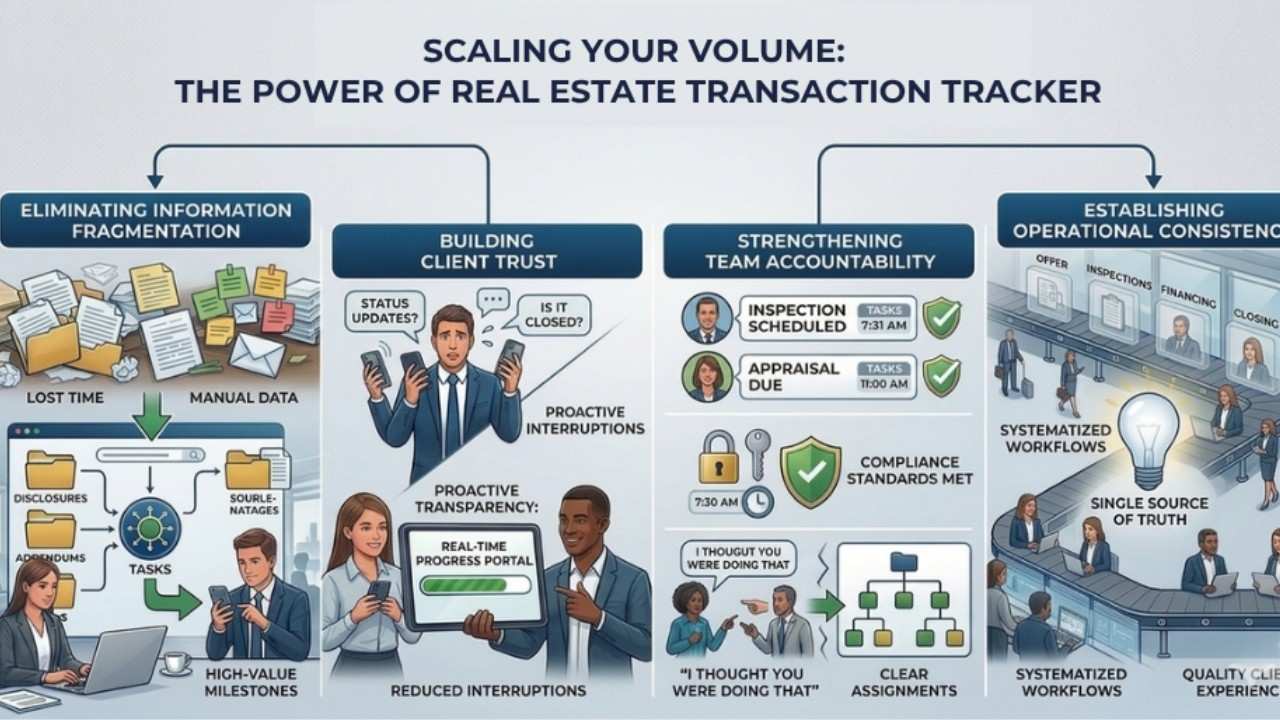
In today’s nonstop real estate market, manual tracking kills your edge. You can’t scale when deals depend on memory, messy emails, or sticky notes. A real estate transaction tracker builds the infrastructure to turn chaotic growth into a high-volume operation.
Eliminating Information Fragmentation
Scale is often restricted by the time lost to manual data retrieval. By centralizing your tracking of workflow, every disclosure, addendum and task is tied directly to property record. It removes the administrative friction caused by searching through different channels, enabling you to stay focused on high-value milestones and revenue-generating tasks.
Building Client Trust via a Real Estate Transaction Tracker
Client inquiries regarding deal status are a significant drain on daily productivity. When you use a transaction tracker to provide stakeholders with a real-time progress portal, you satisfy the need for information automatically. This proactive transparency reduces “status update” interruptions, building professional trust while freeing your schedule for listing appointments and lead generation.
Strengthening Team Accountability and Compliance
As your volume grows, the “Single Point of Failure” risk increases. A dedicated transaction tracker records every occurrence with its detailed timestamp and permanence. When you assign who does what by when, the “I thought you were doing that” confusion goes away.
Through this internal accountability, compliance standards are met on every deal so that your commission and your brokerage are protected from avoidable errors.
Establishing Operational Consistency
To scale successfully, a business must function independently of a single person’s constant oversight. A real estate transaction tracker allows a team member or transaction coordinator to access the “single source of truth” and understand the exact status of a deal instantly. This level of systematized workflow is what enables high-producing teams to manage increased deal flow without compromising the quality of the client experience.
Essential Features of a High-Performing Real Estate Transaction Tracker

To move from manual chaos to a systematized workflow, your transaction management software must do more than list tasks, it must automate the “heavy lifting” of the contract-to-close process.
1. AI-Powered Transaction Creation
The “manual” professional spends hours on data entry; the “scalable” professional uses AI. Modern real estate transaction management software offer AI data extraction features that can extract key data from your contracts to build the transaction for you. This technology instantly identifies key dates and details to speed up deal creation, significantly reducing the “mental load” and time required to move a deal into your pipeline.
2. Dynamic Task Templates and Automation
A high-performing real estate transaction tracker doesn’t require you to reinvent the wheel for every deal. It must provide customizable pre-built templates that automatically triggers a certain sequence of tasks depending on the type of deal (buyer, listing, etc.) This ensures the consistency of operations while eliminating gaps in critical steps.
3. Collaborative Task Assignment for Clients and Partners
A deal should never grind to a halt because a stakeholder missed a request. High-performing transaction management software allows you to assign tasks to real estate clients and transaction partners. When you set expectations and deadlines within the system, you eliminate the need to manually chase someone through email, resulting in a coordinated proactive process.
4. Visual Dashboards and Secure Transaction Sharing
Scale is only possible when you have instant visibility. A visual dashboard shows every active deal in one view with color coded bubbles which highlights the status of the deal progress, while secure transaction sharing allows you to grant real-time access to brokerages or team members. This eliminates the need for manual status reporting; authorized parties stay updated in real-time without constant follow-up emails.
5. Centralized Document Management
Your tracker must serve as the one source of truth for every PDF and addendum to mitigate information fragmentation. A document management feature ensures that your files are linked directly to the property record. Your files are audit-ready and can be accessed by your entire team from any device.
6. Integrated CRM and Prospect Dashboards
The transaction begins long before the contract is signed. An in-built CRM which enables you to track client lifecycle through a prospect dashboard. It maintains a record of activity logs and can send you reminders if a buyer agreement is noticed to be missing or close to expiring ahead of time, making sure compliance happens before the high-risk closing period takes place.
7. Deadline Tracking and Stakeholder Portals
A missed contingency is a high-cost liability. A professional tracker uses automated logic to calculate and monitor deadlines, sending alerts before a window closes. By providing real estate clients and transaction partners with a dedicated portal, you offer a transparent window into the deal’s progress, building immense professional trust while protecting your schedule from “status update” interruptions.
How to Implement a Real Estate Transaction Tracker in Your Business

Shifting towards a real estate transaction management system may initially appear to be a significant transition; however, when approached correctly, the process is seamless and exceptionally productive. The objective here is to replace manual chaos with a planned sequence of work that conserves time and enhances consistency.
Step 1: Map Out Your Current Workflow
Before implementing any new systems, take some time to write down how your transactions currently move from contract to close. Note down each step in detail. Include who is responsible for what in each step along with deadlines.
This will allow you to design your system better, and fit your workflow.
Step 2: Build Your Templates First
Once you choose your transaction management software, focus on setting up your templates before anything else. This includes your task lists, timelines, and standard workflows for different types of transactions.
By following a consistent deal structure, the creation of a new deal has less manual effort and improved accuracy.
Step 3: Train Your Team for Consistency
If you are working with team members or transaction coordinator, you have to train them and make sure that everyone knows how the system operates. Set clear expectations to them when it comes to task updates, handling of documents as well as communication with the client. When everyone in the transaction follows the same structured process, it will be easier to manage a high volume of transactions.
Step 4: Educate Your Clients on the Process
Explain the system to your clients at the start of every transaction. Illustrate how updates will be communicated, as well as the status of progress that is visible via the portal. Clients know where they are in the process in real time, feel empowered, which lowers follow-up calls and improves experience.
How TCs Manage High Volume Using a Real Estate Transaction Tracker

Transaction Coordinators (TCs) face a unique version of the “messy middle.” Their primary struggle isn’t just managing one deal; it is the mental load of managing 30 to 50 files across ten different agents, each with their own unique “system.” Without a dedicated real estate transaction tracker, TCs are forced to live in a state of constant manual auditing, which is the fastest route to professional exhaustion.
Solving the "Mental Load" Struggle with a Real Estate Transaction Tracker
When a TC has to manually open 50 separate folders every morning just to check which disclosures are missing, they aren’t being productive, they are fighting a “system problem.” A high-performing tracker solves this by providing intelligent workload filtering.
Instead of manual checking, the tracker surfaces only the files that require immediate action. This allows the TC to “manage by exception,” clearing the brain fog of high-volume coordination and ensuring that no critical document falls through the cracks.
Standardizing "Agent Chaos" with a Real Estate Transaction Tracker
One of the biggest pain points for a TC is the lack of consistency between the agents they support. Jumping between Agent A’s spreadsheet and Agent B’s sticky notes creates “context-switching fatigue.”
A tracker solves this by providing customizable workflow templates. By standardizing the process within the tracker, the TC can apply a consistent, high-level service to every file regardless of the agent’s personal habits. This creates a repeatable “engine” for the TC’s business, allowing them to scale their volume without sacrificing their precision or their sanity.
How High-Producing Agents Use a Tracker to Buy Back Their Time

While TCs use a tracker to manage the “mess,” Agents use it to manage their freedom. For a solo agent or a team lead, the struggle isn’t just about organization, it’s about the “mental drag” of knowing you have five escrows open while you’re trying to focus on a new listing presentation. Without a system, you’re never truly “off the clock.”
Killing the "2:00 AM" Anxiety
The biggest energy drain for an agent is the constant fear that something is falling through the cracks. A tracker acts as your “digital eyes.” No more wondering whether the earnest money hit or a contingency deadline is approaching, simply view a visual dashboard that gives you the signal on what needs attention next. The visibility clears the mental clutter, and allows you to be 100% present in a listing presentation rather than concerned about your pendings.
Breaking the Growth Ceiling
Most agents hit a wall because their current deals eat up all their bandwidth. A tracker breaks that ceiling by systematizing the repetitive. By automating the status updates and document requests that usually kill your afternoon, you create the space to handle double the volume. You stop being a “firefighter” jumping between crises and start being a business owner with a predictable, scalable engine.
Delivering a "White-Glove" Client Experience
Your reputation is good or bad based on how your clients feel informed during their transaction process. Even one deadline is missed that leads to delayed closing and turns a happy client into a frustrated one. A transaction tracker will make sure that every client gets a high-end experience, no matter how busy you are. Branded portals and automated milestones don’t just manage a transaction, they deliver a professional service that turns one-time buyers into lifelong referral sources.
Why Trackxi Is the Ultimate Real Estate Transaction Tracker for Solving Workflow Chaos
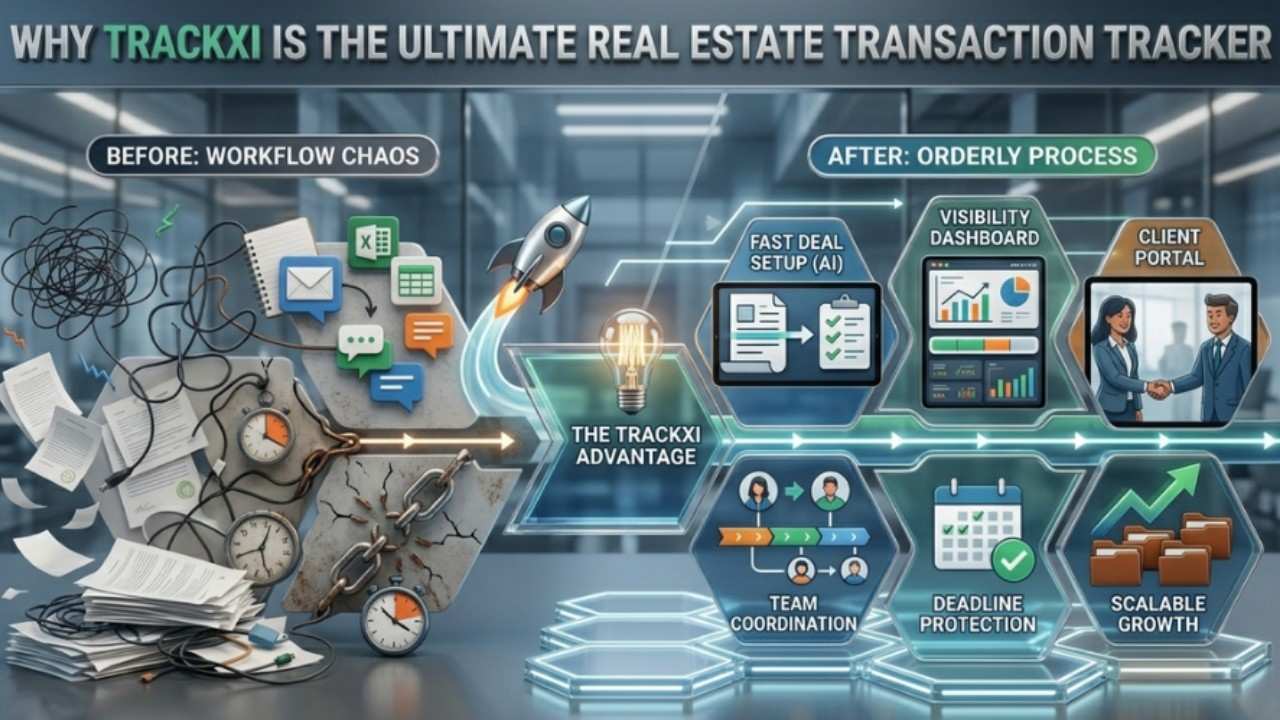
Trackxi is designed to eliminate the everyday breakdowns that slow down real estate agents and transaction coordinators. Instead of juggling disconnected tools, it brings every part of the transaction process into one structured system for faster, clearer, and more reliable deal management.
- AI-Driven Speed and Faster Deal Setup: Trackxi reduces manual work by automatically capturing key contract details and turning them into structured milestones. This helps teams move from contract to action quickly without repetitive data entry.
- Clear, Real-Time Pipeline Visibility: A visual dashboard gives you an instant view of all active transactions in one place, so you always know what stage each deal is in and what needs attention next.
- Transparent Client Experience: Clients can access real-time updates through a dedicated portal, reducing the need for constant follow-ups and improving communication throughout the transaction.
- Stronger Team Coordination and Accountability: Tasks can be assigned and tracked within the system, ensuring agents, coordinators, and partners stay aligned and no step gets missed or delayed.
- Compliance and Deadline Protection: Automated reminders and activity tracking help ensure critical deadlines are never overlooked, supporting smoother and more compliant transactions.
- Designed for Scalable Growth: Standardized workflows and reusable templates allow teams to handle increasing transaction volume without losing control, accuracy, or consistency.
Transition from Struggling to Scaling with a Real Estate Transaction Tracker
The gap between contract and close is where your reputation and your business growth are determined. Relying on a robust real estate transaction tracker isn’t just about being organized; it’s about reclaiming your time and providing a “white-glove” experience that turns one-time clients into lifelong referrals.
Ready to Master Your Real Estate Transaction Tracker?
If you’re tired of the “messy middle” and the constant administrative struggle, it’s time for a professional upgrade. Trackxi was built specifically to solve the friction that holds real estate pros back. From AI-powered contract reading to visual timelines that “wow” your clients, we provide the infrastructure so you can focus on the relationships.
Stop the Struggle. Start Your Free Trial with Trackxi and Close Your Next Deal with Ease.
Frequently Asked Questions about Real Estate Transaction Tracker
A real estate transaction tracker is a tool used by real estate agents, transaction coordinators and others involved in a real estate transaction. The transaction tracker is used from contract to close to organize all of the tasks, deadlines, documents and communication that are required to finalize a transaction and complete a real estate deal more efficiently.
Real estate transaction tracker helps agents and TCs to automate and streamline paper-heavy workflows, eliminating the need to manually keep track of dates and processes. The trackers save time and reduce the likelihood of transactions going past crucial deadlines. It also helps keep all parties involved active and aware of the deal progress in real-time.
Real estate transaction tracker is crucial for scaling real estate businesses. It not only brings standardized workflow, but also goes one step further by taking away the need for manual process and helps real estate agents and transaction coordinators scale their businesses by handling more deals without losing control.
A real estate transaction tracker should include:
- AI-powered transaction creation
- Task automation
- Collaborative task assignment
- Visual dashboards
- Centralized document management
- Integrated CRM
- Deadline tracking
- Client and partner portals
For a solo agent, a transaction tracker acts as a digital assistant. When they are the only person handling marketing, showings, and paperwork, you are the "single point of failure."
A tracker is worth the investment because it:
- Own Your Time: It automates the hours of "status update" emails and document chasing that eat your afternoons.
- Stop the Brain Drain: You no longer have to remember every deadline for every deal; the system does it for you.
- Look Like a Team of Ten: Professional portals give your clients a high-end experience that a solo agent typically can't provide manually.
- Scale Without the Mess: It provides the infrastructure to double your deal flow without doubling your stress.
