
How to Manage Real Estate Transactions: A Complete Guide for Agents, Teams, and Transaction Coordinators

Struggling to keep real estate deals organized? You’re not alone.
Managing real estate transactions is where deals either stay on track or slowly fall apart. Every professional eventually reaches a tipping point where “closing deals” starts feeling like managing chaos across fragmented emails, documents, and shifting deadlines.
If you’ve faced situations like these, you’ve seen the hidden cost of manual workflows:
- A client is waiting for an update you haven’t sent yet.
- A buyer agreement is missing or not updated in the transaction file.
- A deadline has slipped past unnoticed, putting the escrow at risk.
- The file you needed an hour ago is buried deep in a cluttered inbox.
The issue is not effort, it’s the lack of a structured transaction management system.
In transactions, there are various parties involved like buyers, sellers, lenders, and title teams all functioning at the same time. In the absence of an efficient transaction management system, even the most experienced agents tend to react to the situation rather than manage their growth.
This guide will help you manage transactions effectively, minimize delays, and build a scalable workflow.
What Does It Really Mean to Manage Real Estate Transactions Effectively?

Understanding what managing real estate transactions effectively entails will allow you to begin solving your workflow’s inefficiencies. Many agents confuse being busy with actually managing a transaction. Sending messages, following up on calls, and handling documents are tasks, but they are not a proper way of managing a deal from start to finish.
Real estate transactions management refers to the handling of a property deal in a clear and accurate manner at every level from an offer being accepted until the closing takes place. Moreover, the deal is managed without missing out on important steps, deadlines or documents.
The 4 Pillars of Effective Transaction Management
To manage real estate transactions properly, a few key things must always be under control:
Keeping Everyone Involved on the Same Page
A real estate transaction involves not only the buyer and seller but also the lender, inspector, and attorneys. Good transaction management means that everyone gets the right information, at the right time, no misunderstandings, no chasing for follow-ups.
Tracking Important Deadlines
Each transaction will have a number of fixed events such as inspection day, loan approval, paperwork submission, and the closing date. Effective transaction management is based on tightly monitoring these whole process milestones so you don’t miss or delay anything.
Handling Documents in the Right Order
Collecting, updating, and retaining contracts, disclosures and agreements as well as other approvals should be done with diligence and efficiency. Unable to find the right documents or working with old risk assessments, can ruin deals and delay closing.
Centralized Communication
Keep all the updates in one centralized deal history, accessible to the entire team. Avoid scattering messages across emails, texts, and separate platforms.
The Path to Scalability
Once you understand what effective transaction management looks like, it is not hard to spot the gaps of your current process.
Having that insight leads you to establish a more efficient workflow which enables you to manage a greater number of transactions without additional stress or manual work.
Key Challenges in Managing Real Estate Transactions
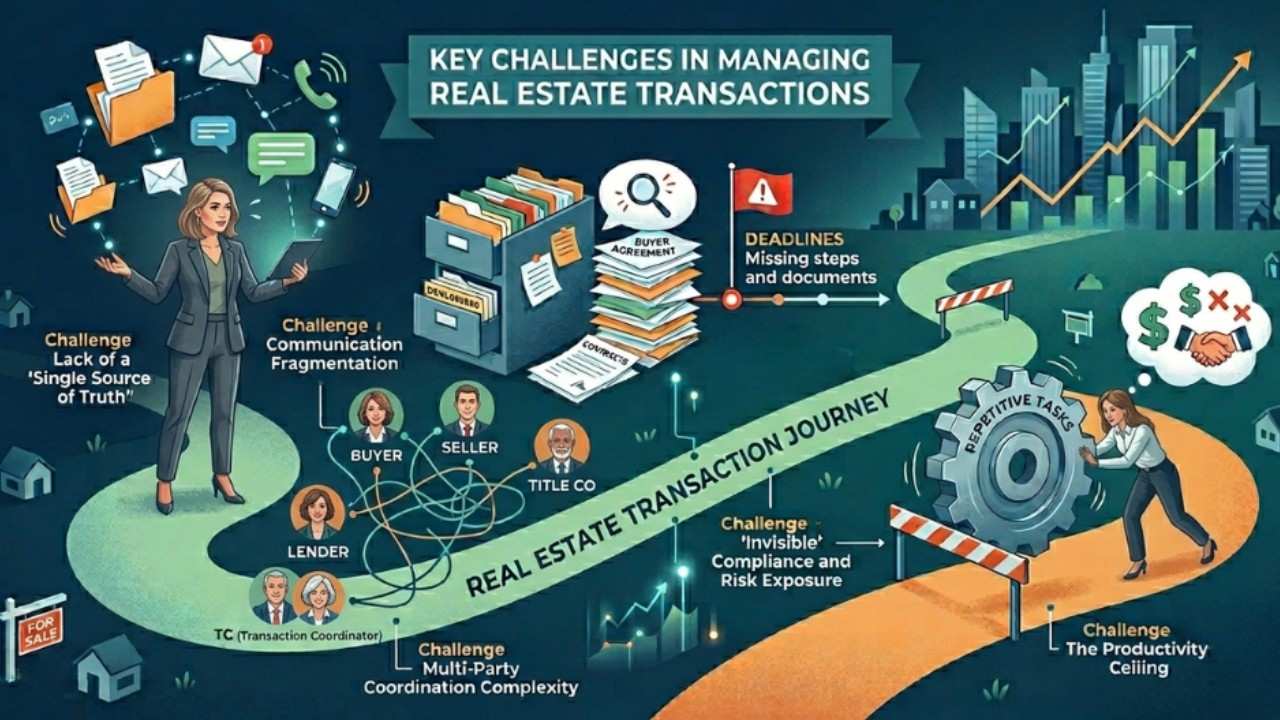
If managing a real estate deal feels more exhausting than it used to, it’s not just your workload, it’s the way transactions have evolved. The industry is no longer about doing paperwork only; it is about quickly moving multi-party coordination where timing, communication and accuracy are all important at the same time.
Below are the main problems that are currently hindering the productivity of agents, teams, and transaction coordinators.
1. The Lack of a "Single Source of Truth"
The majority of agents use emails, folders and spreadsheets to manage deals which scatter the information in multiple places.
The Result: Deadlines get buried in overflowing inboxes, and important documents go missing or get duplicated. Teams end up spending more time searching for information than actually managing the deal.
Without a centralized system, keeping control of a transaction becomes difficult as the number of deals increases.
2. Communication Fragmentation
A single real estate transaction involves buyers, sellers, lenders, title companies, and transaction coordinators. Communication usually happens across:
- WhatsApp or text messages
- Phone calls
- Internal chat tools
Since updates will be shared in different places, it can be hard for everyone to know what information has already been shared or what has been completed.
The Result: Transaction coordinators spend more time repeating status updates, clients often feel uncertain about where things stand, and agents are constantly responding to “what’s the update?” requests. Teams end up spending more time communicating progress than actually moving the deal forward.
This slows down the entire workflow.
3. “Invisible” Compliance and Risk Exposure
Most real estate transactions involve multiple required documents such as disclosures, buyer agreements, contracts, addendums, and approval records. However, when tracking is manual, compliance steps can easily be missed or delayed without immediate notice.
The Result: Missing a single document or an expired timeline doesn’t just delay the deal; it creates legal complications and damages your professional reputation.
4. The Productivity Ceiling
One of the biggest challenges in transaction management is the amount of time spent on repetitive coordination tasks.
Agents and transaction coordinators often spend hours:
- Following up for document updates
- Checking deal status repeatedly
- Confirming deadlines manually
- Searching for missing files
The Result: The most impacted by this are the things that matter most (lead generation, relationship building/management, closing deals) takes a big hit. The increasing number of transactions makes this even more challenging. This also has a stark negative impact on productivity.
5. Multi-Party Coordination Complexity
Real estate deals require many different parties to be kept in the loop, get their approvals, and be coordinated across the spectrum.
Without structure, team members:
- Fail to communicate critical updates to key stakeholders
- Overlook responsibilities due to unclear task delegation
- Miss time-sensitive actions that require immediate attention
- Become overwhelmed managing instructions from multiple parties simultaneously.
Individuals take too long to do things that could be done right now, and can’t control the many instruction steps in a transaction.
A Step-by-Step Guide to Managing Real Estate Transactions Effectively
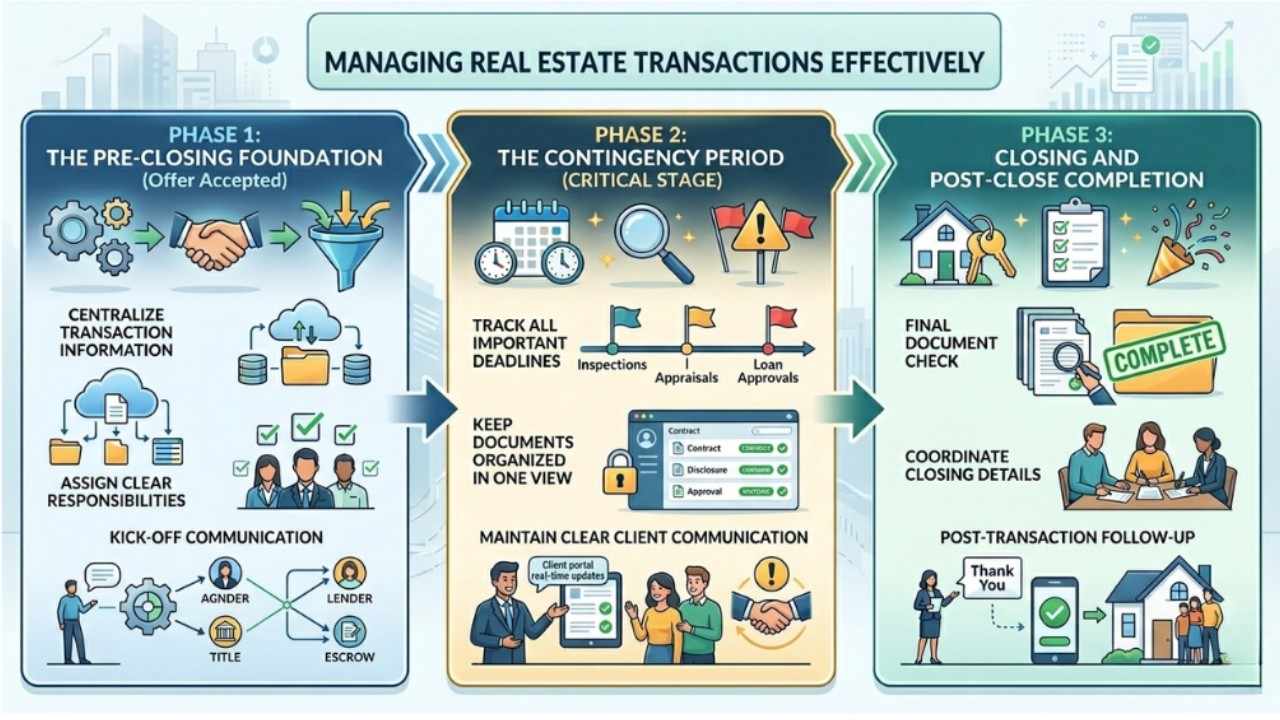
The aim for a successful real estate deal is to get multiple parties, who are engaged to complete actions in a sequence, to function in a coordinated way, where communication is clear, and timeliness and order is of the essence. With such a structured transaction in place, the deal is finalized with minimal delays and no confusion.
To manage real estate transactions effectively, a clear framework can be designed, with the following three main pillars in place.
Phase 1: The Pre-Closing Foundation
Once an offer is accepted, the transaction officially begins. This early stage sets the tone for the entire deal.
Centralize the Transaction Information
Remove deal information from email threads and consolidate everything into a single and accessible location for the team to receive the latest information. This prevents disorder and makes sure that everyone is operating from the same set of facts.
Assign Clear Responsibilities
The task of each person involved in the transaction should be clearly defined. They should know clear delineation of tasks from day one, such as document gathering, client communication and lender coordination.
Kick-Off Communication
Connect investor, lender, title company and escrow team with initial details of the deal. This allows everyone to be on the same page about timelines and expectations from the beginning.
Phase 2: The Contingency Period (Critical Stage)
Delays, blockages, miscommunications in this stage can significantly impact the transaction.
Track All Important Deadlines
Inspection dates, appraisal timelines, loan approvals and contingency periods all need to be tracked in real time so that important process steps are not neglected.
Having Documents Organized in One Location
Contracts, disclosures and approvals need to be kept in one place and regularly updated so those checking may easily determine what is complete or and what is still pending.
Maintain Clear Client Communication
Regular updates for clients reduce confusion and prevent the need to call again 10 minutes later and ask for a “status check”. Client trust increases when they can clearly see progress.
Phase 3: Closing and Post-Close Completion
The final stage is about ensuring everything is complete and properly documented before closing.
Final Document Check
You should go through all documents before closing to avoid anything going wrong. This helps prevent last-minute delays.
Coordinate Closing Details
Buyers, sellers, and title teams should all be aligned on signing schedules and final steps to ensure a smooth closing process.
Post-Transaction Follow-Up
Keeping in contact with clients via feedback or follow-up emails offers that opportunity to build trust and strengthens the chances of returning business after closing.
Must-Have Features of a Modern Real Estate Transaction Management System

Simple spreadsheets or manual checklists are no longer sufficient to manage transactions in a rapidly changing market. To move from managing scattered tasks to managing structured growth, real estate professionals need a centralized system that simplifies coordination, improves visibility, and reduces manual effort.
Here are the essential features every modern real estate transaction management system should have.
1. A Visual Transaction Dashboard
A modern transaction management system should provide a single, real-time view of all your deals. This ensures you always know exactly what’s happening without digging through emails or folders.
The Trackxi Advantage: Trackxi provides a visual dashboard with color-coded bubbles which helps you view your entire transaction pipeline at a glance and determine which deals are on track, which ones are pending action, and which require immediate action.
2. Task Assignment & Automatic Reminders
Real estate transactions involve multiple parties which can lead to delays in coordination of these steps unless each component is actively tracked. The solution is a system that clearly distributes duties and automates notifications to ensure accountability.
The Trackxi Advantage: The client (buyer & seller) can directly assign tasks to partners such as lender, escrow officer, title teams and inspectors. Automated reminders keep everyone on track without the need for constant manual follow-ups or message reminders.
3. Real-Time Client and Partner Portals
Clients want constant updates, because they don’t really know what is going on behind the scenes. This gap is eliminated by a transparent system.
The Trackxi Advantage: Stakeholders can log in at any time to see the status of their transactions in real-time via client and partner portals that are fully set up. Fewer calls for status checks enhance trustworthiness via transparent communication and interactions.
4. Standardized Workflows & Templates
Every transaction follows a similar structure, but many teams still recreate processes from scratch each time. This leads to inconsistency and missed steps.
The Trackxi Advantage: Pre-built Templates make it possible to streamline the team’s processes for each transaction. After creation, the same structure can be used in all of the deals to maintain consistency and minimize errors.
5. Automated Deadline & Milestone Tracking
Important dates can be missed if it is done manually, particularly when handling multiple transactions simultaneously.
The Trackxi Advantage: Key milestones such as inspection periods, appraisal dates, and loan contingencies are automatically calculated based on contract details. These deadlines sync with calendars and trigger alerts before any important step is missed.
6. Centralized Document Management
Locating the right version of a document is challenging when they are distributed among emails, drives, and local folders.
The Trackxi Advantage: The system consolidates all contracts, addendums, disclosures, and reports. No more confusion about document versions, and everything is conveniently accessible.
7. Buyer Agreement & Compliance Tracking
Transaction management starts even before a deal is fully active. Keeping track of agreements and compliance early helps prevent issues later in the process.
The Trackxi Advantage: The system includes dedicated tracking for buyer agreements and prospect-level compliance, helping agents identify missing or expired documents early and stay fully prepared before a deal enters escrow.
Manage Real Estate Transactions with Confidence Using Trackxi

Effective real estate transaction management isn’t just about keeping things organized, it’s about building a system that actually lets you scale without the constant stress or operational mess.
With an appropriate structure, everyone involved becomes more effective:
- Instead of chasing manual updates, agents can concentrate on the clients and closing deals.
- Real Estate Teams have complete insight into the entire pipeline, and they are able to handle large volumes.
- Transaction Coordinators can execute workflows and track compliance without the need for manual follow-ups.
Trackxi brings it all together, your deal tracking, tasks, deadlines, and documents, into a single workspace. It’s about keeping the whole team aligned from the first signature to the final closing. The outcome is simple: less friction and way more clarity.
Ready to manage real estate transactions effectively?
Don’t let manual tasks slow your growth. Experience the clarity and scalability that comes with a streamlined system. Start your free trial with Trackxi today!
Frequently Asked Questions About Managing Real Estate Transactions
To manage real estate transactions effectively, you need a structured workflow that tracks every deal from the initial offer submission until the deal closes. Each step should include clear task delegation, tracking deadlines and flagging pending steps or actions, documented record-keeping and milestone tracking for each deal, and open communication with all relevant parties involved in the transaction.
The biggest challenges are the lack of a centralized system, missed deadlines, poor communication and inability to track documents. Such problems may cause delays, compliance risks, and a decrease in productivity when handling multiple transactions.
Modern transaction management software is useful for managing real estate transactions by offering features such as automation of tasks, deadline management, centralized document storage, and a real-time communication portal. These tools will decrease the amount of manual work and enhance visibility into each deal.
