
The “Set It and Forget It” Transaction: Using Workflow Automation to Meet Every Real Estate Deadline

It’s late Thursday afternoon. Closing is scheduled in less than 48 hours. During a routine file review, someone on your team suddenly realizes a critical compliance task was completely missed.
The earnest money deposit receipt was never uploaded. The mortgage lender is still waiting on a final document. A vital contract contingency step remains incomplete because everyone on the team assumed someone else had already handled it.
Now, because of the lack of workflow automation, the entire team is rushing to fix a problem that should have been caught and resolved days ago.
As transaction volume increases, manual coordination becomes harder to manage consistently. Tasks get buried in inboxes, updates disappear inside message threads, and important follow-ups depend too heavily on memory and constant checking.
That growing operational pressure is exactly why workflow efficiency has become a major focus across the real estate industry. According to the National Association of REALTORS® 2025 technology survey, 66% of realtors say they are adopting emerging technology tools to streamline workflows, reduce manual administrative work and spend more time on higher-value activities.
That is where workflow automation changes the process completely.
Instead of relying on people to manually track every next step, workflow automation creates structured transaction workflows that automatically assign responsibilities, trigger reminders, surface incomplete tasks, and keep deals progressing before small delays turn into closing problems.
The result is not just better organization. It has fewer last-minute surprises, a smoother contract-to-close transaction flow, reduced operational stress, and a process that feels consistently under control, even during high transaction volume.
The Hidden Cost of Managing Transactions Without Workflow Automation
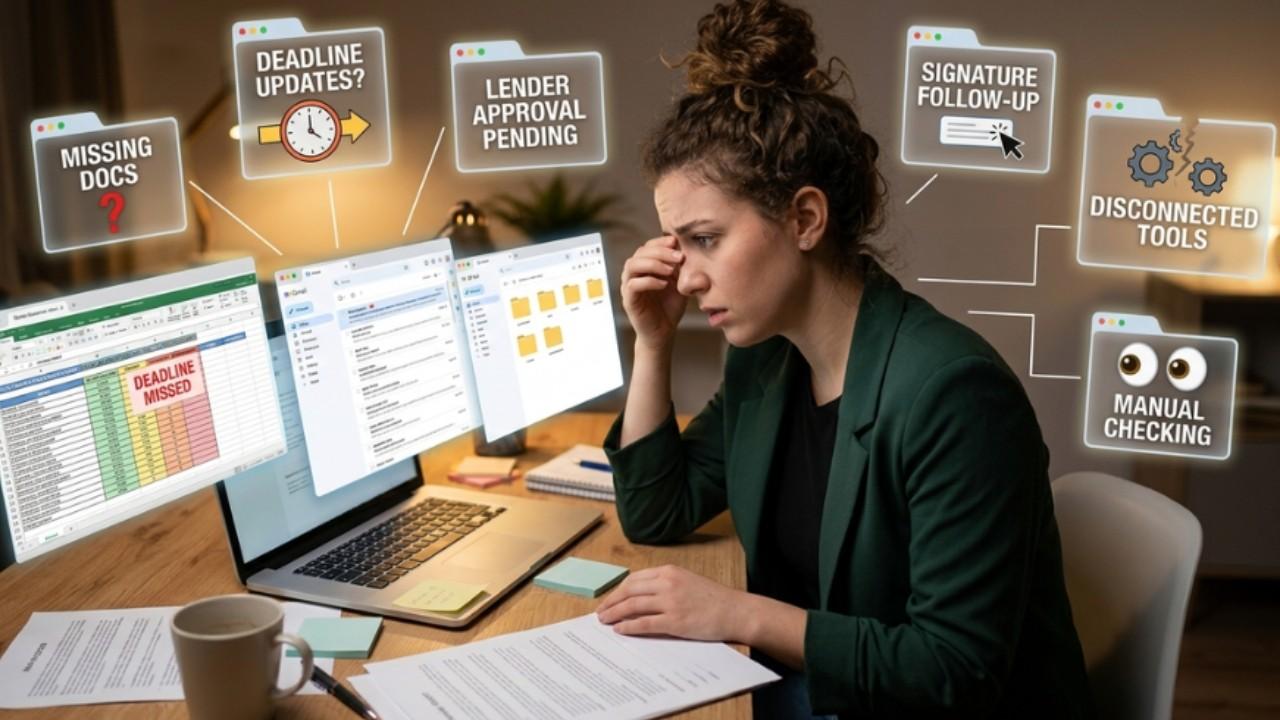
Most real estate agents, teams and transaction coordinators do not notice operational inefficiency immediately. At first, manual transaction management simply feels like part of the job; checking emails for updates, tracking deadlines in spreadsheets, reviewing missing documents, and following up across multiple parties to keep transactions moving.
But as the deal volume grows, those little admin actions start taking more time than the actual transaction itself. Instead of focusing on negotiations, client relationships, and closing coordination, teams become trapped in repetitive operational work that constantly demands attention.
1. Important Tasks Often Get Discovered Too Late
One of the biggest problems in manual transaction management is not that tasks are ignored entirely. It is that incomplete tasks are often discovered only after they start affecting the closing timeline.
A lender document may still be waiting for review inside an inbox. A disclosure requirement may remain incomplete because responsibility was assumed instead of clearly assigned. A contingency deadline may need updating after a timeline extension, but the related tasks were never adjusted accordingly.
As a result, transaction coordinators often reopen the same files multiple times a day just to verify whether documents were uploaded, signatures were collected, or approvals were received.
Instead of having clear, real-time transaction visibility, teams end up doing this constant manual checking, bouncing through emails , spreadsheets , shared folders, calendars and message threads all the time.
That reactive workflow creates unnecessary closing pressure because operational gaps are usually identified only after timelines are already affected, turning preventable issues into last-minute transaction problems.
2. Disconnected Systems Slow Down Transaction Progress
Many real estate agents and teams still manage real estate transactions across separate tools that do not communicate with each other efficiently.
- Documents may exist in one platform.
- Deadlines may live inside a calendar.
- Conversations may stay buried in inboxes or text messages.
- Task tracking may happen separately in spreadsheets or project boards.
As information becomes scattered across multiple systems, transaction workflows lose consistency. Agents constantly switch between platforms to track progress, verify updates, and coordinate next steps Even simple workflow changes often require manual coordination across multiple tools.
As transaction activity increases, teams spend more time reconnecting information across systems than actually progressing deals, which slows response times, increases coordination errors, and makes transactions harder to manage consistently.
3. Manual Follow-Ups Create Operational Fatigue
Real estate transactions involve constant follow-ups throughout the transaction lifecycle.
- Checking whether documents were signed
- Confirming earnest money was received
- Requesting lender updates
- Following up on missing compliance items
- Reminding clients about pending actions
When these activities depend entirely on manual coordination, teams gradually shift from proactively managing transactions to continuously reacting to incomplete tasks and delayed responses.
Transaction coordinators spend more time monitoring files than progressing deals. Agents repeatedly ask for updates because transaction status is unclear. Small administrative tasks begin interrupting productivity throughout the day.
Over time, that constant follow-up cycle reduces productivity across the entire team, pulling coordinators and agents away from higher-value transaction work that directly impacts client experience and closing efficiency.
4. Small Workflow Gaps Quietly Become Closing Problems
Most transaction delays do not begin as major issues.
They usually start as small unresolved workflow gaps that slowly affect the entire closing process.
- One delayed signature slows lender review
- One missing upload affects compliance verification
- One overlooked reminder creates unnecessary urgency near closing
Individually, these problems appear minor.
Across multiple active transactions, these small workflow gaps create compounding operational pressure that increases closing delays, reduces transaction predictability, and forces teams into constant reactive coordination.
5. Scaling Becomes Difficult Without Structured Workflows
Manual transaction management may feel manageable with a smaller pipeline. But as brokerages grow, maintaining consistent execution becomes increasingly difficult without workflow automation.
More transactions create:
- More deadlines to monitor
- More documents to track
- More communication to manage
- More follow-ups to coordinate
- More opportunities for tasks to be missed
Without workflow automation, growth often increases operational strain faster than operational control. Making it harder for agents and teams to scale transaction volume without adding coordination stress, execution inconsistency, and closing risk.
This is exactly why workflow automation has become essential for modern real estate operations.
Not simply to improve organization, but to create transaction workflows that remain structured, scalable, and consistently controlled, even during high transaction volume.
Workflow Automation in Real Estate: What It Actually Means
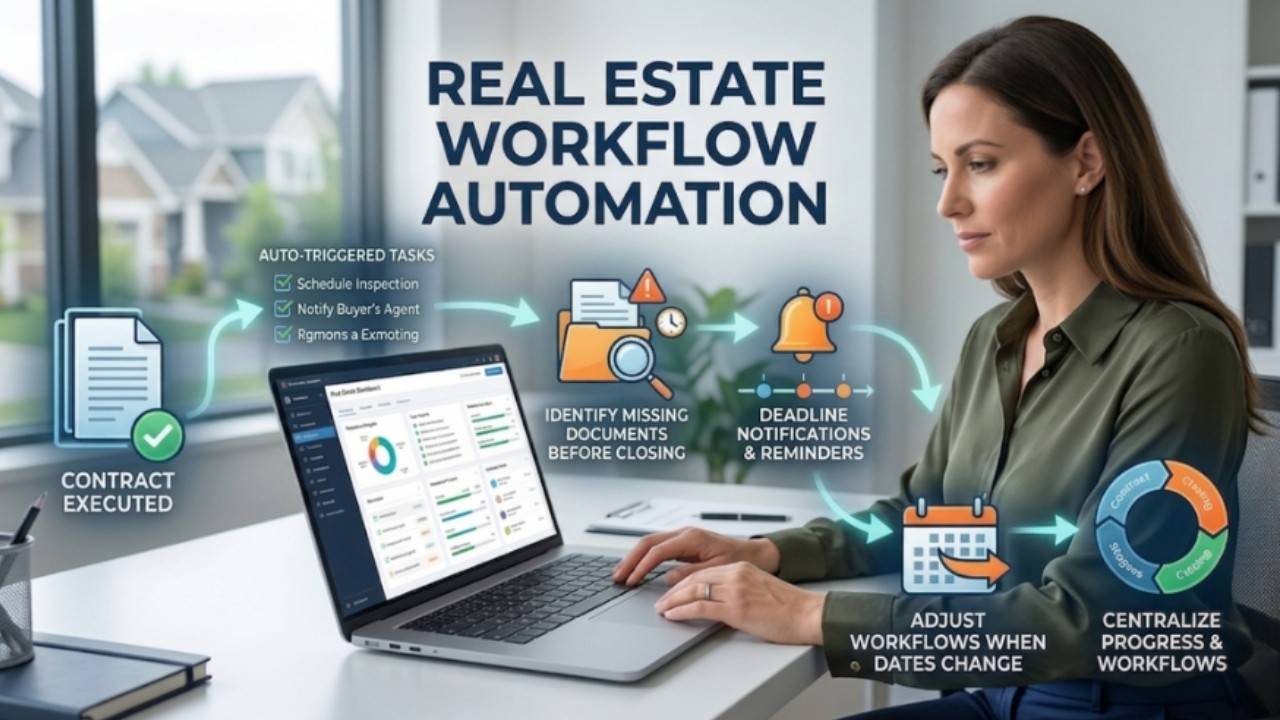
Workflow automation in real estate is not about completely replacing human touch with automated systems. It is about creating a transaction process where important tasks, deadlines, and next steps continue progressing without depending entirely on manual coordination.
In a lot of real estate deals, teams still lean on memory, spreadsheets, inboxes, calendars, and those repetitive follow-ups to keep everything progressing. Agents manually note down the timelines, coordinators go back and forth to confirm what documents are missing, and teams waste a good amount of time double-checking that the key steps have actually been done the right way.
Workflow automation changes this by introducing structured scalable workflows that move transactions forward in a consistent sequence as each step is completed.
When one stage is finished, the next required action is triggered automatically. Deadlines stay organized, pending tasks are easier to manage, and transaction progress can be understood without repeatedly switching between tools or reopening files.
For example, workflow automation can:
- Trigger tasks automatically after contract execution
- Identify missing documents before they impact closing timelines
- Notify responsible parties ahead of deadlines
- Adjust workflows when transaction dates change
- Centralize progress across the full transaction lifecycle
Instead of leaning on constant manual coordination, workflow automation builds a structured system where the transaction steps move forward in a predictable and controlled way from the contract to closing.
How Workflow Automation Improves Real Estate Transactions

Workflow automation enhances real estate transactions by eliminating tedious manual processes. Instead of relying on a person to move pieces of a transaction from the contract stage to the closing stage, workflow automation drives tasks, deadlines, documents, and communication in a structured and automated way.
1. AI Data Extraction for Faster Transaction Setup
AI transaction management software like Trackxi includes an AI data extraction feature that automatically pulls out the key details from uploaded documents, then quickly turns that into a structured transaction. Trackxi lets agents process contracts up to 4x faster, and that helps speed up the whole transaction setup process.
Based on the extracted information, the system automatically generates a complete task list with timelines, ensuring that every critical step is mapped from the beginning of the transaction lifecycle without manual setup delays.
This helps cut down onboarding time a lot, while also reducing data entry errors, and it makes sure every transaction begins with full and correct details. So, agents and coordinators can go straight into execution, rather than wasting time on admin setup work.
2. Task & Transaction Management with Clear Ownership
Workflow automation enables agents to assign tasks to their real estate clients and transaction partners based on the transaction stage and their respective roles. Each task is built with clear deadlines and defined ownership, This increases accountability for all parties involved in the transaction.
This improves coordination by eliminating ambiguity around responsibilities and reducing dependency on manual follow-ups. It helps prevent missed actions, avoids duplicate communication, and ensures that every step in the transaction lifecycle is actively tracked and completed on time.
3. Visual Dashboard for Real-Time Transaction Control
At a glance, a real-time view is presented on a central dashboard that includes status indicators for the progress of the transaction, indicating how it is moving forward, what needs to occur next, and any areas that might experience a delay.
Agents and coordinators get the speed to better informed decisions, because instead of trying to track progress across the disparate tools and the many separate updates, the team can now clearly view the areas that are slowing things down, what actions need to occur next, and can maintain better control.
4. Automated Deadline Tracking for Risk-Free Transaction Timelines
Deadline tracking is continuously managed based on contract terms, contingencies, and transaction milestones. Key dates such as inspections, document submissions, and closing timelines are monitored automatically.
This reduces the risk of missed deadlines, eliminates manual date calculations, and ensures that upcoming obligations are flagged early. Teams gain more control over time-sensitive actions, resulting in fewer last-minute escalations and smoother closing cycles.
5. Automated Follow-Ups and Reminders for Better Task Completion
Automated notifications keep all stakeholders informed when tasks are pending, require attention, or are completed. Instead of relying on manual reminders and repeated status checks, the system automatically sends alerts and upcoming deadline notifications to the relevant parties.
This reduces coordination overhead, prevents tasks from being overlooked, and improves response times across agents, clients, and external partners. This creates faster transaction flows. Communication delays tend to decrease.
6. Document Management Linked to Transactions
All transaction documents are tied directly to their respective deals, so there’s a structured and easy to access document flow through the whole lifecycle of the transaction.
This improves compliance readiness, reduces the time spent searching for files, and makes sure that if documentation is missing it gets noticed early too. It also streamlines coordination between agents, lenders, and closing teams by keeping all required files in one organized workflow.
Workflow Automation: The “Set It and Forget It” Advantage

The phrase “set it and forget it” does not mean ignoring transactions or removing human oversight. It means building workflows that are reliable enough that agents no longer need to manually manage every administrative operational step throughout the transaction process.
Instead of constantly checking whether tasks were completed, workflow automation ensures that transactions continue progressing through structured, predefined steps.
This shift creates a more stable and predictable way of managing real estate transactions.
This creates several long-term advantages:
- Reduced administrative overload
- Faster transaction movement
- Better deadline consistency
- Improved operational scalability
- More predictable client experiences
- Lower compliance risk
- Less coordinator burnout
The most significant impact is not just efficiency, it is the ability to focus on high-value, revenue-generating work that actually drives scalability.
Take Control of Your Transactions with Trackxi
As transaction volume goes up, keeping things consistent across deadlines, communication and documentation starts to feel hard, unless there is a structured system in place.
Trackxi brings structure to this process by centralizing transaction workflows into a single, organized system where tasks, deadlines, documents, and responsibilities move together from contract to closing. Instead of managing deals between disconnected tools and doing all that manual coordination, teams get a more reliable method to carry out the whole transaction end to end, without that constant back and forth.
This allows real estate agents, teams and transaction coordinators to operate with greater consistency, reduce operational friction, and scale without adding coordination complexity.
When transactions are structured through workflow automation, execution becomes more predictable and teams can focus on progressing deals rather than managing administrative workload.
Start your free Trackxi trial today and experience how Trackxi automates workflows, reduces administrative workload, improves transaction visibility, and supports scalable growth.
Frequently Asked Questions About Workflow Automation
Workflow automation is a system that streamlines real estate transactions by using automation of repetitive administrative responsibilities and managing deadlines, documents and communications from contract to closing.
It eliminates repetitive administrative steps like manual data entry and constant status requests, allowing teams to reclaim time for client-facing work. By centralizing transaction records into a single system, automation keeps agents, coordinators, and clients perfectly aligned without relying on scattered emails or manual follow-up chains.
As transaction volume grows, manual tracking inevitably leads to operational fatigue. Workflow automation introduces a structured foundation that provides clear pipeline visibility and explicit task ownership. This ensures that even when managing a busy pipeline, every single deal is executed with consistent quality, compliance, and control.
Yes. Most closing delays happen when missing compliance forms or incomplete contract contingencies are discovered too late. Automation solves this by tracking escrow milestones dynamically and flagging missing actions early, stopping last-minute scrambles well before they can impact your closing date.
