
Is Follow Up Boss Transaction Management Too Clunky? What Real Estate Agents Need to Know
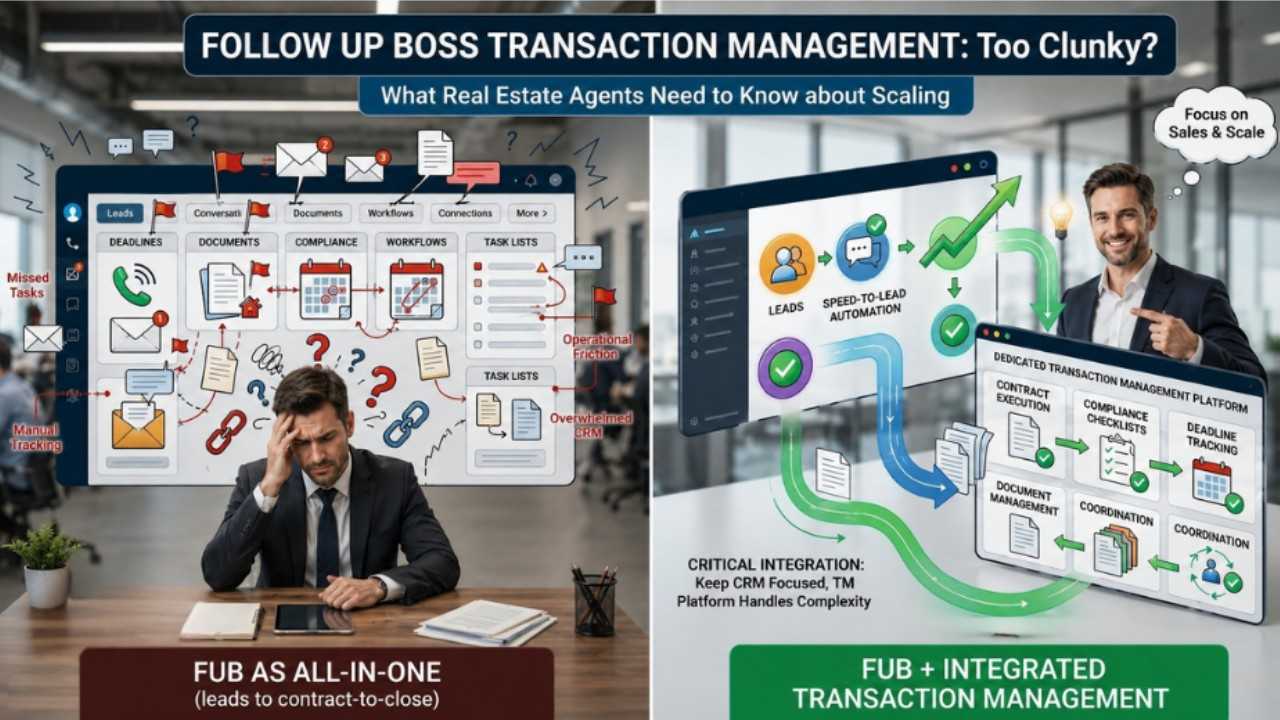
If you ask any top-producing real estate agent what CRM they rely on, Follow Up Boss (FUB) is almost always at the top of the list. It’s widely trusted for lead management, speed-to-lead automation, smart routing, and helping agents stay consistent with follow-ups.
But once a lead converts and moves into contract, a very different question starts to surface:
Can Follow Up Boss actually handle full transaction management at scale, or does it start to feel clunky once agents move from leads to contract-to-close stage?
This is where many agents find themselves at a crossroads.
Real estate agents can lose roughly 40 hours per transaction due to inefficient processes like manual paperwork, signature tracking, and multi-party coordination. These inefficiencies go beyond lost productivity, often resulting in delays and increased operational friction.
Some agents try to extend their CRM, Follow Up Boss by building custom pipelines, automations, and workflow systems inside the CRM. Others realize that transaction execution requires a more structured, purpose-built system and begin exploring dedicated transaction management platforms that integrate with FUB to keep everything connected without overwhelming the CRM.
And that decision is not just about convenience, it’s about scalability.
Because while Follow Up Boss works extremely well as a front-end sales CRM, transaction workflows introduce a different level of complexity: deadlines, compliance tracking, document management, coordination between multiple parties, and strict closing timelines.
Trying to force all of that into a CRM designed primarily for lead management often leads to gaps; missed tasks, manual tracking, and increasing operational friction as volume grows.
That’s why many agents eventually adopt a dedicated transaction management system that integrates with Follow Up Boss, allowing them to keep their CRM focused on what it does best, while a specialized platform handles the contract-to-close process with structure and automation.
Where Follow Up Boss Works Well for Agents

Before even looking at where challenges begin, it’s essential to understand why Follow Up Boss (FUB) is probably one of the most used CRMs among real estate agents. Basically, FUB is built with one main intention: letting agents manage their leads and keep follow-ups more consistent. And honestly, in that part, it performs really well.
Most agents end up using Follow Up Boss for things like:
- Quick lead capture from multiple sources (Zillow, websites, referrals, ads)
- Automatic lead routing and distribution
- Speed-to-lead follow-up via calls, texts, and emails
- Smart lists for lead segmentation and prioritization
- Lead pipeline visibility
- Follow-up nudges and action plans
- Communication tracking and lead nurturing
This is where FUB really shines, it keeps agents organized up near the top of the funnel, so no lead feels ignored or unattended.
In fact the whole platform is sort of designed around getting faster responses and improving lead conversion, which is one of the biggest success factors in real estate.
At this point, Follow Up Boss works like a solid operational system for handling conversations, logging activity, and making sure follow-up stays consistent across the whole team.
Where Transaction Management Starts to Feel Clunky

Once agents move into active contracts, the whole process shifts away from lead management and into execution mode. At this stage, whether things go well or not depends on keeping the deadlines, documents, inspections, and lender coordination on track, and honestly, there are multiple moving parts that need to remain aligned until closing.
This is where Follow Up Boss, while strong as a CRM, begins to show limitations when used for full transaction management at scale. Instead of a structured contract-to-close system, agents often experience operational friction in several key areas.
Lack of Structured Contract-to-Close Workflow
Follow Up Boss is designed around lead pipelines, not transaction execution.
As a result, agents often struggle with:
- No standardized workflow from contract to close
- Inconsistent processes across different agents or teams
- Difficulty ensuring every transaction follows the same steps
This leads to variation in execution quality and increased dependency on individual habits rather than system-driven processes.
Weak Task Management for Transaction Execution
While FUB supports tasks, transaction-level execution often becomes difficult to manage at scale.
Common challenges include:
- Tasks created manually for every deal stage
- No automatic task progression based on milestones
- Difficulty tracking task completion across multiple deals
- Tasks getting buried alongside general CRM activity
Over time, this makes it significantly harder for agents to maintain consistency across active transactions without dropping the ball.
Limited Accountability Across Deals
As transaction volume increases, accountability becomes harder to enforce inside a CRM built primarily for leads.
Agents often face:
- Unclear ownership of specific transaction steps
- Difficulty verifying whether tasks were actually completed
- Limited oversight for team leaders and brokers
- Dependence on manual follow-ups instead of system enforcement
This reduces transparency across the contract-to-close process.
Poor Visibility Into Transaction Progress
Most CRM deal boards provide only a high-level lead pipeline view.
This creates challenges such as:
- Unclear status of individual transaction milestones
- Difficulty identifying delayed or at-risk deals
- Lack of real-time operational insight across all contracts
As a result, agents and transaction coordinators often have to manually check multiple outside sources just to understand a single deal’s actual progress.
Fragmented Tools and Communication
During transactions, information is often scattered across multiple platforms:
- Email threads
- Text messages
- Spreadsheets or checklists
- External task tools
This fragmentation increases the risk of missed updates, duplicated work, and communication gaps between agents, clients, and coordinating parties.
Why Agents Move to a Dedicated Transaction Management System That Integrates With FUB
As agents grow and transaction volume increases, the way they think about their CRM naturally evolves.
At first, most agents try to manage everything inside Follow Up Boss from leads to ongoing deals. But over time, a shift begins to happen in how they approach their workflow. Instead of stretching a CRM beyond its original purpose, agents begin to rethink how their systems should be structured.
This shift is not about dissatisfaction with Follow Up Boss. It is about recognizing that different stages of the real estate process require different operational approaches.
- Lead management and client communication operate in one layer
- Contract-to-close execution operates in another
At the same time, agents do not want disconnected tools or scattered systems. Forcing team members to hop between isolated platforms creates fragmented workflows, leads to double data entry, and makes it incredibly hard to maintain a clear view of active transactions.
As this operational reality becomes clearer, agents naturally move toward a setup where systems are connected and integrate with their existing CRM rather than replacing it.
How a Dedicated Transaction Management System like Trackxi Solves These Challenges

A dedicated best transaction management system like Trackxi is built to simplify, and speed up the whole contract to close process, by combining AI automation with structured workflows and real time visibility all in one connected platform.
Rather than depending on manual updates in a CRM like Follow Up Boss, Trackxi works as a dedicated execution layer , so every transaction keeps moving ahead with clarity, faster pacing and consistent handling.
This creates a connected workflow where Follow Up Boss continues to manage leads, while Trackxi manages transaction execution from contract to close.
1. AI-Powered Data Extraction for Faster Transaction Setup
Trackxi uses AI to automatically pull out key details from contracts—like dates, parties, contingencies, and other transaction specific info. It lets the system process contracts up to 4X faster, and then instant convert them into structured workflows within seconds.
So agents can go from the contract to actual execution without those operational delays. It also removes manual data entry, and makes sure the most critical transaction information is captured and put in order with high accuracy from the very beginning.
2. Visual Dashboard for Complete Transaction Visibility
Trackxi offers a centralized, visual dashboard that shows all the active transactions into a single real time view. Rather than jumping between spreadsheets, emails, or CRM pipelines, agents can immediately check where each deal stands, what needs attention, and which transactions truly require immediate focus.
It gives operational clarity across the whole pipeline, helps agents quickly spot delays or underlying risks, and it makes prioritizing the daily execution tasks easier without that constant manual checking.
3. Clear Task Assignment for Better Accountability
Trackxi allows agents to assign tasks directly to clients and partners like lenders, title companies, inspectors, photographers, and other transaction partners involved in the deal. Every person can clearly see what they are responsible for, which deadlines they have, and what exact actions they need to take. Whereas agents receive real-time visibility to task progress and task completion.
This improves accountability across the entire transaction by creating clear ownership for every task, increasing transparency between all parties, and ensuring everyone knows exactly what needs to be completed and when. As a result, agents spend less time chasing updates, communication gaps are reduced, and transactions move forward with greater consistency and control.
4. Automated Task and Deadline Management
Trackxi automatically generates and manages tasks based on transaction milestones, deadlines, and workflow stages. Each transaction is continuously updated with the next required action, ensuring nothing is missed during the contract-to-close process.
This makes sure every critical step gets surfaced at the right time, transaction progress stays consistent without leaning on manual tracking, and the execution ends up more structured and predictable for all active deals.
5. Transaction Task Templates for Structured Workflows
Trackxi provides customizable transaction templates that define the entire contract-to-close workflow in advance. Instead of creating processes from scratch for every deal, agents can apply a ready-made structure that includes all required steps and milestones.
This ensures every transaction follows a consistent execution flow, teams operate with a standardized process across all deals, and new agents or coordinators can quickly adapt without extensive training.
6. Automated Reminders and Follow-Ups
Trackxi triggers automatic reminders and follow ups, based on certain milestones, deadlines, and transaction activity. These smarter pings make sure every important action gets done at the right moment throughout the whole deal lifecycle.
This keeps transactions moving forward without delays, maintains consistent communication across all stages, and removes dependency on manual tracking or memory-based follow-ups.
7.Centralized Document and Compliance Management
Trackxi keeps contracts, documents, and transaction-related files organized in one centralized location. Instead of searching through emails, shared drives, or multiple systems, agents can access critical documents directly within the transaction workflow.
Trackxi also integrates with SkySlope, allowing teams to connect transaction execution with compliance management. This helps make sure the necessary documents get submitted, reviewed, and kept up to date inside the current compliance process, while reducing the amount of admin effort.
This creates a more streamlined path from transaction execution to compliance review, helping agents stay organized, maintain complete transaction records, and move deals toward closing with greater confidence.
8. Seamless Integration with Follow Up Boss
Trackxi has a two-way integration with Follow Up Boss, enabling agents to connect their CRM directly with their transaction management system without disrupting existing workflows.
This integration allows agents to continue using Follow Up Boss as their primary CRM for lead generation, communication, and pipeline management, while Trackxi manages the full contract-to-close transaction process in a structured and automated environment.
All contact data, updates, and transaction-related information are synced between both platforms, ensuring consistency and eliminating the need for manual data transfer. This creates a seamless flow of information across the entire deal lifecycle.
By keeping both systems connected, agents are able to maintain Follow Up Boss as their central system for relationships and leads, while Trackxi operates as the execution layer for transactions, deadlines, tasks, and closing activities in real time.
This ensures agents don’t have to swap out their current CRM, but rather add on top with a dedicated transaction management system that works in sync with their existing workflow.
Ready to Simplify Your Transaction Management Process?
If your team is already using Follow Up Boss for lead management, the goal isn’t to replace it — it’s to make it work better across your entire real estate workflow.
As transaction volume grows, most agents realize that managing everything inside a CRM can create operational friction when it comes to deadlines, coordination, and contract-to-close execution. That’s where a dedicated transaction management system like Trackxi becomes the missing execution layer.
Instead of forcing your CRM to handle both lead management and transaction operations, Trackxi allows you to keep Follow Up Boss focused on what it does best, while giving your team a structured system to manage transactions with clarity, automation, and control.
- Follow Up Boss for leads and relationships
- Trackxi for transaction execution and closing workflows
Together, they create a complete, connected workflow from first lead to final closing without scattered tools or manual tracking.
If you’re evaluating whether your current setup can scale with your business, the best next step is to see how a dedicated transaction management system integrates with Follow Up Boss in real time.
Book your live Trackxi Demo today and see the Trackxi + Follow Up Boss Integration in action.
Frequently Asked Questions About Transaction Management
Yes. Follow Up Boss is an elite sales CRM that allows you to track deals using custom pipelines and stages. However, because it is built for lead generation and relationships, top-producing teams often pair it with a dedicated transaction management system to handle complex closing details like document compliance and automated deadline tracking.
Integrating Follow Up Boss with a specialized tool like Trackxi gives agents the best of both worlds. It keeps your sales team focused on lead conversion inside FUB, while automatically pushing active contracts into a structured execution layer—eliminating double data entry and preventing missed deadlines.
Not at all. A true two-way transaction management integration works silently in the background. Your agents continue using Follow Up Boss exactly as they do now for daily communication, while contact details and deal updates automatically sync with your contract-to-close platform in real time.
Automated transaction management eliminates chaos by acting as a single, shared source of truth for the entire contract-to-close process. Instead of scattering updates across text threads, endless emails, and messy spreadsheets, an integrated transaction management platform centralizes everything and automates transaction creation, task tracking, reminders, and follow-ups.
