
How Real Estate Teams Can Scale Transaction Management Without Losing Control

Growing transaction volume is a good sign for a real estate team. More contracts can mean more opportunities, more revenue, and a business that is gaining momentum.
But growth also changes how a team needs to operate.
A process that works well for 5 or 10 active transactions can become difficult to maintain when a team is managing 25, 50, or more. More deals bring more deadlines, documents, handoffs, follow-ups, stakeholders, exceptions, and decisions competing for the team’s attention.
The challenge isn’t simply handling a larger number of transactions. It’s increasing the team’s transaction capacity without allowing administrative work, missed steps, and communication gaps to increase at the same rate.
That is the foundation of scalable transaction management.
For real estate teams, the objective is to refine the process to such an extent that everyone can see the process, knows who is responsible for the next step, and can identify which transactions require attention, all without relying on the team’s manual coordination to manage the process and without losing control.
Successful implementation of an operation designed for scalability means a real estate team is able to grow the number of transactions executed while maintaining quality and consistency.
What Does It Mean to Scale Transaction Management?

Scaling transaction management means increasing the number of transactions a real estate team can handle without allowing administrative effort and operational complexity to increase at the same rate.
Consider a team that grows from 10 active transactions to 30.
If each transaction is managed through individual spreadsheets, email threads, personal reminders, and manually recreated checklists, administrative work can quickly become a bottleneck. The team isn’t just managing more transactions; it’s managing more coordination.
A scalable process works differently. Predictable work is standardized, responsibilities are clearly assigned, transaction information is centralized, and repetitive activities are automated. This allows the team to increase transaction capacity without simply increasing administrative workload.
Think of it this way:
More transactions + the same manual process = greater operational pressure
More transactions + a scalable process = greater transaction capacity
The difference becomes increasingly important as a real estate team grows. The goal isn’t simply to process more transactions. It’s to build a repeatable transaction management operation that can support higher volume without sacrificing visibility, accountability, or quality.
Transaction Volume Is Not the Same as Transaction Capacity

A team can manage a high volume of transactions without having the operational capacity to handle that workload efficiently.
Transaction volume tells you how many active deals a team is managing.
Transaction capacity is the amount of transaction work that the team can do consistently and on time, without missing any deadlines, with regards to communication, accuracy, quality, and client service.
Two real estate teams could each have 20 active transactions and still experience significantly different workloads.
One team may rely on standardized workflows, clear task ownership, centralized transaction information, and automated reminders.
Another may depend on:
- Spreadsheets
- Email searches
- Individual calendars
- Manual checklists
- Repeated data entry
- Status requests
- Personal notes
- Manual follow-ups
The transaction volume is the same. The operational effort required to manage that volume is not.
This is why growing teams need to look beyond the number of active transactions. They also need to understand how much administrative effort each transaction requires and where their team’s capacity is being consumed.
When repetitive coordination takes up more of the team’s time, adding transactions can increase workload faster than the team’s ability to handle it. A scalable process helps close that gap by reducing unnecessary administrative effort and making more capacity available for work that requires human attention.
Why Growing Transaction Volume Creates Operational Complexity

Every real estate transaction contains a combination of predictable and unpredictable work.
A single transaction may involve:
- Contract deadlines
- Inspection and appraisal milestones
- Financing updates
- Title or escrow activity
- Documents and signatures
- Buyer and seller communication
- Agent coordination
- Vendor communication
- Closing preparation
- Amendments and exceptions
When one transaction is active, keeping track of these items may be manageable.
When 20 or 30 transactions are active at the same time, the challenge changes.
An inspection issue on one file may require attention while another transaction is waiting for lender confirmation and a third is approaching closing.
The problem is no longer simply completing individual tasks.
It is coordinating competing priorities across an entire transaction pipeline.
That is where many growing teams discover that their existing processes are no longer designed for the volume they are handling.
Where Growing Real Estate Teams Lose Transaction Capacity

Before adding more people or technology, real estate teams should identify where their existing transaction capacity is being consumed.
As transaction volume grows, small administrative tasks can become significant sources of workload. The biggest capacity drains often come from repetitive work, information gaps, interruptions, and manual coordination.
1. Manual Data Entry During Transaction Setup
Setting up a new transaction can require reviewing lengthy purchase agreements, finding key details, and manually entering them into the transaction record.
This may include:
- Property details
- Buyer and seller information
- Purchase price
- Contract dates
- Important milestones
- Transaction contacts
Repeating this process for every new transaction can quickly consume team capacity as volume grows.
2. Rebuilding the Same Workflow for Every Deal
Many transactions follow similar stages, such as:
- New contract setup
- Document collection
- Inspection
- Financing
- Appraisal
- Title or escrow
- Closing preparation
When team members recreate the same task lists and processes for every transaction, they spend time rebuilding work that could be handled consistently.
As transaction volume increases, this repeated effort becomes a growing administrative burden.
3. Searching for Transaction Information
Transaction information can become difficult to find when it is spread across emails, spreadsheets, shared drives, messages, notes, and task lists.
A simple question like:
“Where are we with this transaction?” may require searching several sources to reconstruct the current status.
That time doesn’t directly move the transaction forward, but it still consumes team capacity.
4. Repeated Status Requests
Agents and team members may regularly ask:
- Has the inspection been completed?
- Did the lender provide an update?
- Are all documents signed?
- What’s still outstanding?
- Are we ready for closing?
Communication is essential, but repeatedly providing basic status updates can create constant interruptions for coordinators.
Across multiple transactions, these interruptions can take significant time away from active transaction work.
5. Unclear Task Ownership
A transaction may involve dozens of tasks and multiple people. When ownership isn’t clear, work can fall through the gaps.
For example:
- Nobody knows who owns the next follow-up.
- Two people assume the other completed a task.
- An overdue item isn’t escalated.
- A coordinator spends time checking who is responsible.
These gaps create additional coordination work while increasing the risk of missed or duplicated tasks.
6. Excessive Context Switching
A coordinator managing multiple transactions may constantly switch between:
- New transaction setup
- Deadline checks
- Follow-ups
- Document requests
- Status questions
- Internal messages
- Exception handling
Frequent switching makes it harder to maintain focus and forces team members to repeatedly reconstruct the context of each transaction.
As volume increases, this context switching can become a significant drain on transaction capacity.
7. Manual Follow-Up and Deadline Monitoring
Every transaction has dates, milestones, and dependencies that require attention.
Teams may need to monitor:
- Inspection deadlines
- Financing milestones
- Appraisal activity
- Document requirements
- Closing dates
- Outstanding responses
- Follow-up commitments
When these are primarily tracked through individual calendars, spreadsheets, reminders, or memory, monitoring itself becomes additional administrative work.
The larger the transaction portfolio, the harder it becomes to keep every deadline and follow-up visible manually.
8. Hidden Work Caused by Exceptions
Not every transaction follows the expected path.
A missing document, delayed lender response, inspection issue, financing problem, or last-minute change can create additional coordination work.
These exceptions may require extra communication, follow-ups, rescheduling, documentation, and escalation.
The problem isn’t that exceptions exist. It’s that manually discovering and coordinating exceptions across a growing transaction portfolio can consume significant team capacity.
The Result: Capacity Gets Consumed Before Teams Realize It
Small administrative tasks can quickly add up across dozens of transactions, consuming time that could be spent moving deals forward.
The key is to reduce this administrative burden before it becomes a bottleneck to team growth.
How to Build a Scalable Transaction Management Process
The first step is to recognize what within the process causes the loss of capacity.
The process becomes truly effective when the workload is consistently reduced and the focus shifts more from transactional work to exceptions.
This allows for an increase in the number of transactions a team can manage while maintaining a standard of high quality and low administrative burden.
1. Get a Clear View of the Entire Transaction Pipeline
Growing teams need more than individual transaction records. They need a clear view of what is happening across the entire pipeline.
Teams should be able to quickly see:
- New transactions
- Upcoming milestones
- Overdue work
- Transactions waiting on others
- Approaching closings
- At-risk transactions
- Team workload
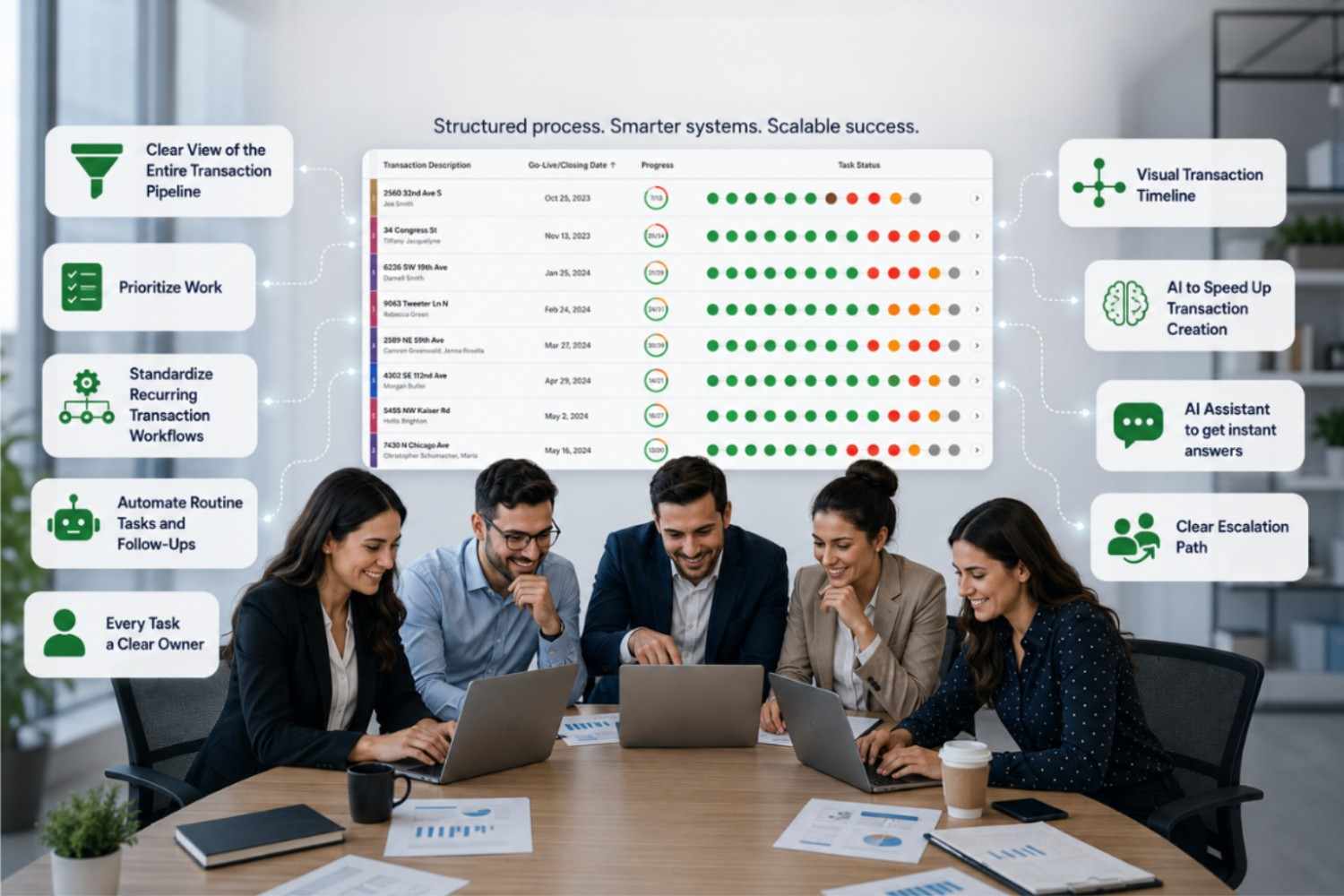
A visual dashboard can bring this information together in one place. Platforms such as Trackxi provide a transaction dashboard which allows the entire transaction pipeline to be viewed at once, understand what attention is needed and track the progress of transactions without having to check them one by one.
2. Prioritize Work Based on Risk and Urgency
Not every transaction requires the same level of attention. A transaction closing tomorrow with everything on track may need less intervention than one closing next week with an unresolved financing issue.
Teams can prioritize based on:
- Deadline
- Dependency
- Risk
- Current status
- Potential impact
- Time available to resolve the issue
Transaction management software can help teams quickly identify upcoming deadlines, outstanding work, and transaction status through visual indicators and color-coded status bubbles, making it easier for transaction coordinators to focus on the files that need attention most.
3. Standardize Recurring Transaction Workflows
Recurring activities shouldn’t have to be recreated for every transaction.
Teams can create repeatable workflows for common stages such as:
- New transaction setup
- Document collection
- Inspection
- Financing
- Appraisal
- Closing preparation
Templates and customizable workflows in platforms like Trackxi can help teams apply consistent processes across transactions without rebuilding the same workflow each time.
This creates a reliable starting point for every transaction while still giving team members flexibility to adjust the workflow when exceptions occur.
4. Automate Routine Tasks and Follow-Ups
Once recurring work is identified, teams can determine which activities don’t require constant manual attention.
This can include:
- Task creation
- Deadline reminders
- Recurring follow-ups
- Notifications
- Workflow actions
Platforms like Trackxi help automate predictable tasks and reminders, reducing the need for coordinators to manually track every deadline or remember every follow-up.
The goal isn’t to automate everything. It’s to reduce repetitive coordination so the team has more capacity for work that requires human attention.
5. Give Every Task a Clear Owner
Every important task should have a clear owner, deadline, and next step.
A well-defined process should make it easy to answer:
What needs to happen?
Who is responsible?
When is it due?
What happens next?
Platforms like Trackxi can connect tasks and responsibilities to specific team members, making ownership clearer and helping reduce duplicated or overlooked work.
Clear ownership also makes handoffs easier when multiple team members work on the same transaction.
6. Keep Dependencies and “Waiting On” Items Visible
Some transaction milestones depend on people outside the team.
Instead of allowing these items to disappear into an inbox, teams should know:
- What is pending
- Who is responsible for the next response
- When follow-up is needed
- Whether the delay could affect the transaction
Platforms like Trackxi provide a visual transaction timeline that helps teams see upcoming milestones, pending activities, and important transaction dates, making it easier to identify what they are waiting on and when follow-up is needed.
This helps teams distinguish between a transaction that is progressing normally and one that needs intervention.
7. Use AI to Speed Up Transaction Creation
Transaction setup can involve reviewing lengthy documents, finding key details, and entering information manually.
AI-powered transaction management platforms like Trackxi can extract key details from uploaded transaction documents, helping teams speed up transaction creation and reduce manual data entry.
For growing teams, reducing this work across every new transaction can free up significant team capacity.
The goal isn’t to replace human judgment. It’s to reduce repetitive work so team members can spend more time on coordination, exceptions, and client needs.
8. Use an AI Assistant to Find Transaction Information Faster
As transaction volume grows, team members may spend significant time searching for information across transaction records, documents, tasks, and updates.
Instead of manually searching through different parts of a transaction, an AI assistant can help team members find relevant information faster and get answers about the transaction when they need them.
AI assistants in platforms like Trackxi can help teams quickly find transaction information, reducing the time spent searching through records and allowing coordinators to focus on moving transactions forward.
9. Create a Clear Escalation Path
A scalable process should define what happens when a transaction moves outside the expected workflow.
For example:
On track → Monitor
Needs attention → Review
At risk → Take action
Escalated → Involve the appropriate person
Resolved → Return to the normal workflow
With centralized transaction visibility, teams can identify overdue or at-risk work earlier and give the right people the information needed to intervene.
A shared escalation process helps teams respond consistently without turning every exception into an emergency.
Build the Process Around the Team, Not Individual Transactions
The goal of scalable transaction management isn’t simply to manage more files. It’s to create a repeatable operating process where the team can see the pipeline, prioritize important work, maintain accountability, and reduce unnecessary manual coordination.
Transaction management platforms like Trackxi bring these capabilities together, helping growing real estate teams increase transaction capacity while maintaining visibility and control.
Scale Your Transaction Management Without Losing Control
Growing transaction volume shouldn’t mean growing administrative work at the same pace. A scalable process helps real estate teams improve visibility, standardize recurring work, automate routine tasks, and give their team more capacity to focus on what matters.
Trackxi brings transaction workflows, AI-powered tools, team visibility, and automation together to help real estate teams manage growing transaction volume with greater control.
Ready to see how Trackxi can help your team scale? Start your 14-day free trial or book a free demo.
Frequently Asked Questions About Scale Transaction Management
Teams can increase transaction capacity by standardizing recurring workflows, automating routine tasks, centralizing information, and reducing repetitive data entry. This allows them to handle more transactions without increasing manual coordination at the same rate.
Transaction volume is the number of active transactions a team manages. Transaction capacity is how much transaction work the team can reliably handle while maintaining deadlines, quality, communication, and client service.
Teams should consider transaction management software when growing transaction volume leads to scattered information, repetitive administrative work, missed deadlines, unclear task ownership, or difficulty monitoring the overall transaction pipeline.
Yes. AI can reduce repetitive work such as extracting information from transaction documents and speeding up transaction creation. It can also help teams find transaction information faster, giving coordinators more time for tasks that require human judgment.
