
Breaking the Document Bottleneck: How the Best Real Estate Document Management Software Speeds Up Closings and Commissions
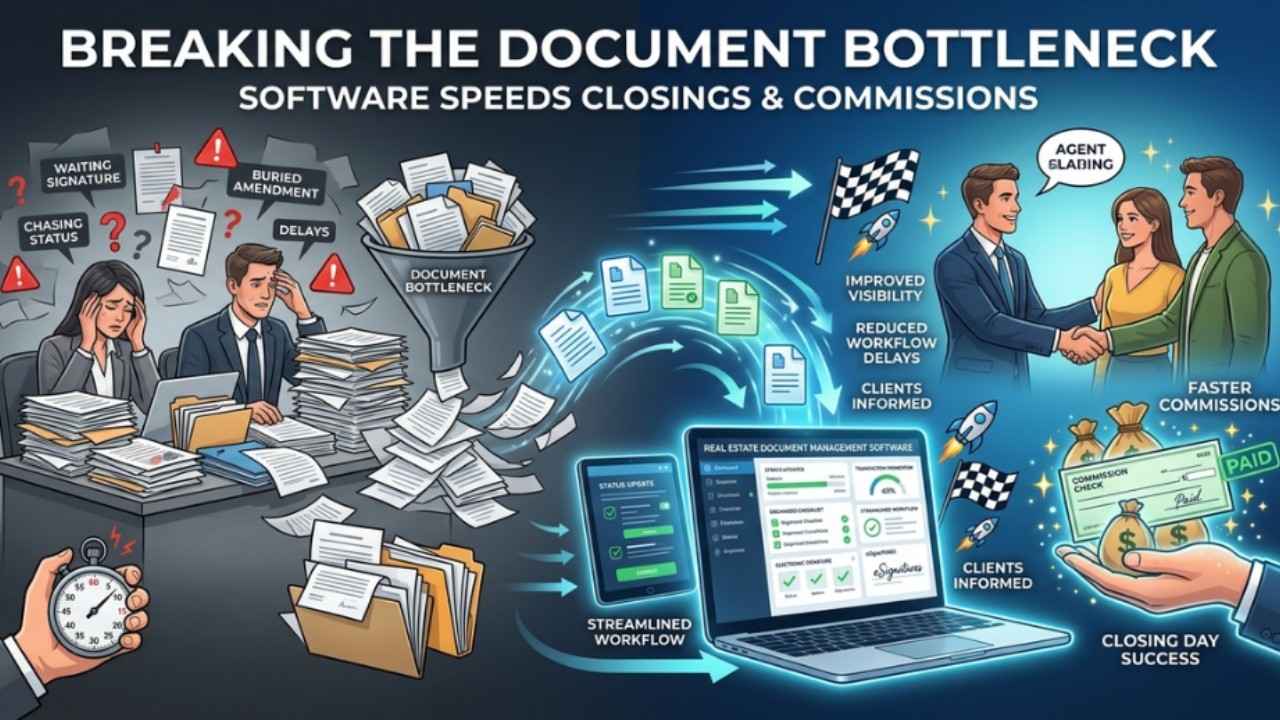
The best real estate document management software does more than organize files, it directly impacts how quickly real estate transactions reach the closing table.
Most real estate transactions don’t get delayed because of major problems.
They get delayed because of dozens of small interruptions that accumulate throughout the deal lifecycle.
A document is waiting for review. A signature request sits unopened. A lender asks for updated paperwork. An amendment gets buried in an email thread. A transaction coordinator spends half the day chasing status updates instead of moving the transaction forward.
Individually, these delays seem minor. Together, they create a document bottleneck that slows transaction progress, drags out the closing timelines, adds more admin work, and delays the commissions too.
In fact, according to a 2026 report from the National Association of REALTORS® (NAR), 13% of contracts experienced delayed settlements in a recent three-month period, highlighting how common transaction delays remain across the real estate industry.
For real estate agents, transaction delays often mean waiting longer to receive earned commissions. For brokers, transaction coordinators, and operations teams, they create additional follow-ups, status checks, and administrative work that takes time away from moving deals toward closing.
The challenge isn’t simply managing documents, it’s about maintaining transaction momentum.
As transaction volume increases, agents and transaction coordinators need more than a place to store files. They need a way to improve visibility, reduce workflow delays, and keep transactions moving from contract to closing without constant follow-ups and manual coordination.
This is why the best real estate document management software has become an essential operational tool for growing teams. When transactions move faster, clients stay informed, administrative burden decreases, and commissions reach the finish line sooner.
Why Transactions Lose Momentum Long Before Closing Day

Most real estate transactions don’t lose momentum at the closing table. They lose momentum in the days and weeks leading up to it.
Every transaction ends up being a chain of related tasks, from gathering the documents and getting the signatures, to checking the paperwork, and coordinating with multiple stakeholders, sort in a sequence. Since each phase usually relies on the previous thing being finished first, even a small delay can end up dragging everything that comes after it.
A lender may be waiting for updated documentation. A transaction coordinator may be following up on a missing form. An agent may be searching for the latest version of an agreement. While none of these situations seem significant on their own, they can gradually interrupt the flow of a transaction and extend the path to closing.
The challenge becomes even greater as transaction volume grows. Documents, approvals, disclosures, amendments, and status updates often move between agents, brokers, transaction coordinators, clients, lenders, title companies, and other parties involved in the transaction.
Maintaining visibility is difficult for active deals when information is scattered through emails, drives, spreadsheets, and communication channels.
And without one centralized place to steer the transaction-related documents, and a way to monitor progress, teams end up spending more time juggling details and coordinating updates than actually moving transactions forward.
This is one of the main areas where momentum is lost. Rather than working toward the goal of closing deals, time is wasted contacting people to check the status of deals, looking for files, and making sure all the forms are done.
The little things that get left for too long are the things that most greatly affect the closing time, the client’s feeling toward the deal, and ultimately the commission check.
The Hidden Cost of Document Bottlenecks in Real Estate

Document bottlenecks rarely appear as a single major problem. More often, they emerge through small operational inefficiencies that gradually disrupt transaction flow and consume valuable time.
A buyer representation agreement nearing expiration goes unnoticed. An amendment is saved in the wrong folder. Multiple versions of the same document circulate across email threads. A lender requests paperwork that someone believed had already been submitted.
Even if these issues look somewhat isolated they still tend to bring in more follow-ups, manual coordination, and last minute trouble shooting that end up slowing the transaction progress down.
Time Spent Managing Delays Instead of Growing the Business
Real estate professionals are most productive when they are serving clients, building relationships, and generating new opportunities. Document bottlenecks shift that focus toward administrative work.
Rather than moving transactions forward, agents are routinely looking for files, confirming status of documents, responding to update queries, and finding the lost information. With more transactions being performed, these interruptions can take up a considerable amount of business hours and reduce the time for profitable operations.
Increased Administrative Burden Across the Team
The operational impact extends beyond agents. Transaction coordinators, brokers, and operations teams frequently become responsible for locating documents, monitoring deadlines, validating paperwork, and ensuring stakeholders have access to the correct information.
When documents are scattered across email inboxes, shared drives, spreadsheets, and multiple systems, keeping real visibility gets more and more hard. What should be a simple transaction flow ends up turning into this chain of manual nudges, ongoing status checks, and document requests
Small Oversights That Create Bigger Delays
Many transaction slowdowns originate from issues that initially appear insignificant. An unsigned disclosure, a missing form, an overlooked amendment, or an expired buyer agreement may not seem urgent until another step in the transaction depends on it.
By the time these issues are found, teams are frequently caught up in reactive problem solving, leading to additional coordination work, and a greater chance of not having deadlines on time.
Client Experience and Growth Opportunities at Risk
Real estate clients rarely see the internal effort required to manage a transaction. What they do notice are delays, repeated requests for information, and uncertainty around next steps.
As these experiences accumulate, client confidence can begin to decline. At the same time, teams handling growing transaction volume may find it increasingly difficult to scale efficiently when administrative work continues to expand alongside every new deal.
The hidden cost of document bottlenecks is not simply misplaced paperwork. It is the time, productivity, transaction capacity, and client confidence that are lost when teams lack visibility into the documents and activities driving every transaction forward.
What the Best Real Estate Document Management Software Actually Needs to Do

To eliminate document bottlenecks, real estate teams need more than a digital storage space. They need a system that actively supports the transaction flow, like reducing uncertainty, boosts visibility and makes sure each document is tied to the right deal at the right moment.
The core issue in most transactions is not just making the document, it is the actual coordination of it. When the file approvals, and the ongoing updates get scattered across emails, drives, and messages, teams quietly lose track of what is already done, what is still pending, and what really needs immediate attention.
A solid real estate document management system is meant to close those gaps and keep deals moving, without unnecessary stops, delays or all that back and forth.
1. Create a Single Source of Truth for Every Transaction
Every document should be directly linked to its specific transaction. Instead of files being stored in disconnected folders or shared across multiple channels, they should live within a structured transaction workspace.
This makes sure agents, transaction coordinators, and brokers always know exactly where a document belongs, what deal it impacts and what stage it is currently in. It also cuts down on that extra time spent looking around for files and it gets rid of the confusion that happens when there are multiple document versions floating around.
2. Bring Real-Time Visibility to Transaction Progress
A key requirement of an effective system is clear visibility into what has been completed and what still requires action. Without this, minor delays, consisting of pending signatures or incomplete disclosures can go ignored until they begin to affect final timelines.
The system should also highlight deadlines like buyer representation agreements that are nearing expiry, waiting on approvals, or unsigned amendments. So they are handled before it turns into a transaction blocker.
This helps teams stay ahead of delays instead of reacting to them at the last minute.
3. Reduce Manual Follow-Ups Through Structured Workflow Tracking
Transaction coordinators and agents usually end up spending a lot of time doing more follow-ups on the document status, approvals, and signatures across several stakeholders.
A well designed system reduces this dependency by structuring tasks, and responsibilities inside the transaction itself. Instead of checking progress manually, teams can see, in real-time, what’s pending and what needs to be moved.
This reduces repetitive communication and allows more focus on moving transactions forward.
4. Prevent Errors Caused by Missing or Outdated Documents
A common issue that causes delays in many transactions is the existence of multiple versions for the same document, or the use of an outdated document to make decisions.
A dependable system enables all documents to be instantly and consistently updated and linked to the respective transaction, and thus provides reduced risks of working with incorrect or incomplete information.
This helps maintain consistency across the entire transaction lifecycle.
5. Improve Coordination Across All Transaction Stakeholders
Real estate transactions involve multiple parties, including agents, brokers, transaction coordinators, lenders, and title companies. Without a structured system, communication becomes fragmented and reactive.
A centralized approach makes sure all stakeholders are using the same information, so it reduces the back and forth communication and it helps better coordination across the whole transaction process.
6. Support Faster Closings Through Structured Transaction Flow
Organized documentation, clear visibility and defined roles help reduce the disruption that often accompanies business transactions.
This standardized process saves a significant amount of time dealing with preventable problems and allows teams to stay on track from contract to closing. This enhances the workflow efficiency over time, improves client’s confidence, and supports more predictable commission payments.
Best Real Estate Document Management Software: Feature-to-Solution

To help agents and teams evaluate platforms quickly, look for a system that maps modern real estate software features directly to the core transaction bottlenecks we’ve discussed:
| Real Estate Problem | What It Actually Causes | What the Software Must Provide |
|---|---|---|
|
Documents scattered across email, drives, and messages |
Time wasted searching for files and confusion over versions |
Centralized transaction-based document storage |
|
Lack of visibility into transaction progress |
Missed steps like unsigned forms or pending approvals |
Real-time transaction visual dashboard |
|
Expiring or missing buyer agreements and disclosures |
Last-minute delays and stalled closings |
Deadline tracking with automated alerts |
|
Manual follow-ups for documents and updates |
Increased workload for agents and transaction coordinators |
Automated follow-ups and reminders |
|
Multiple document versions circulating |
Errors in decision-making and delays due to incorrect or incomplete information |
Version control to ensure only the latest approved file is linked to the transaction |
|
Fragmented communication across stakeholders |
Slow coordination between agents, TCs, lenders, and title teams |
Centralized communication within each transaction |
Moving Beyond the Bottleneck: The Path to Scalable Growth in Real Estate Operations
Document bottlenecks are not an unavoidable part of real estate operations. They are the result of disconnected systems that rely on manual tracking, fragmented communication, and reactive follow-ups to manage active transactions.
When transaction documents, deadlines, and updates are managed within a structured transaction management platform like Trackxi, the way teams operate begins to change. Transaction coordinators can handle higher volumes with fewer delays, agents can stay focused on building their business, and clients experience a clearer and more predictable path to closing.
By not wasting precious time looking for documents or verifying status, your teams can stay productive and manage real estate transaction progress with visibility and control.
Ultimately, accelerating close time and safeguarding commissions is not about working harder, it’s about eliminating the drag on your transactions from the start. A system designed specifically for real estate workflows helps ensure that every deal moves through a clear, organized, and trackable process from contract to close.
Ready to Eliminate Transaction Friction?
Trackxi helps real estate teams bring structure to the contract-to-close process by centralizing documents, improving transaction visibility, and reducing manual coordination across agents, transaction coordinators, and brokers.
Book a Trackxi demo today and experience seamless document management that streamlines your workflow.
Frequently Asked Questions About Best Real Estate Document Management Software
The best real estate document management software goes beyond typical cloud-stored files. It centralizes deal-specific files, automates compliance checklists, and provides real-time milestone visibility. This helps agents, brokers, and TCs accelerate closing and commission cycles.
It helps clear up the document bottlenecks by organizing documents, tracking completion dates, cutting the risk of missing paperwork, and triggering automated follow up reminders to reduce guideline coordination across stakeholders.
Most delays happen due to missing documents, scattered files, manual coordination, and lack of visibility across agents, transaction coordinators, lenders, and title teams.
Yes, it can. Once the document flow gets smoother, mistakes are reduced, and everyone gets real time visibility. That whole thing helps real estate teams push deals along faster, from the agreement stage to actual closing.
